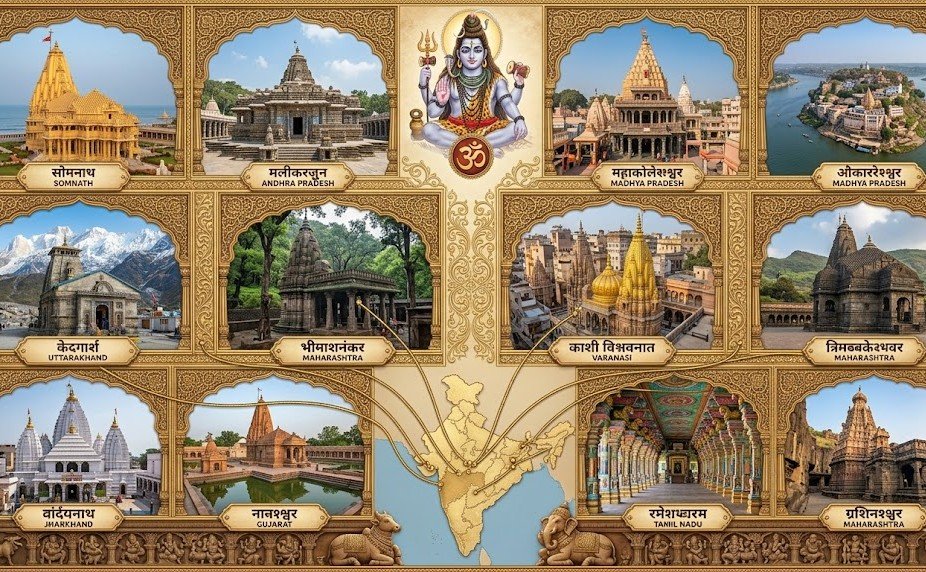
The twelve Jyotirlingas are considered the most sacred shrines of Lord Shiva in all of Hinduism. The word "Jyotirlinga" means "radiant sign of the Almighty" — a pillar of infinite light through which Shiva manifested himself to assert his supremacy over Brahma and Vishnu. Each of the twelve Jyotirlingas is a self-manifested lingam, meaning they are believed to have appeared on their own rather than being installed by human hands. Scattered across the length and breadth of India — from the icy heights of Uttarakhand to the coastal edges of Gujarat and Tamil Nadu — completing a pilgrimage to all twelve is considered one of the most spiritually rewarding journeys a devotee can undertake. This is your complete guide to all twelve Jyotirlingas, with practical travel details, the best time to visit, and how to reach each one.
1. Somnath Jyotirlinga — Veraval, Gujarat
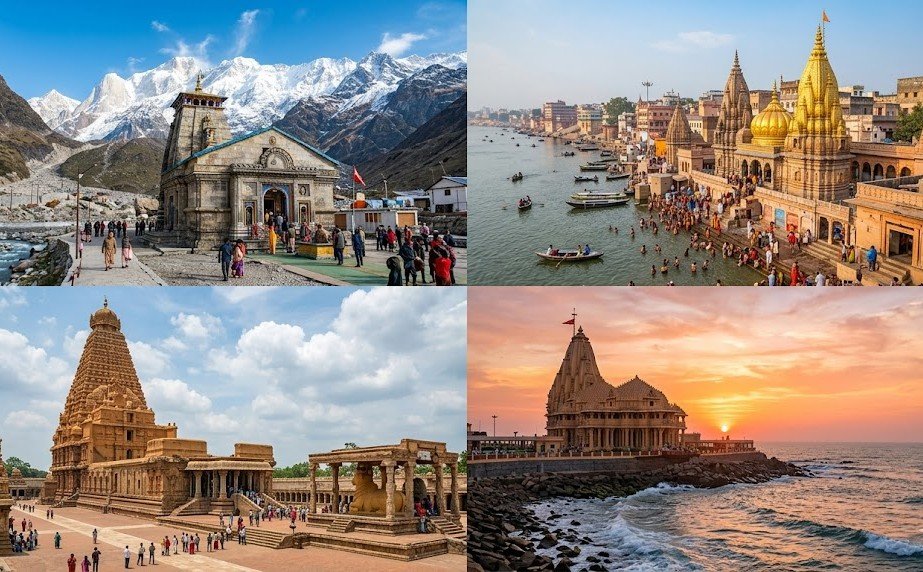
Somnath is the first of the twelve Jyotirlingas and holds a place of unshakeable reverence in Hindu tradition. Located on the western coast of Gujarat near the town of Veraval, this temple has been destroyed and rebuilt at least six times across centuries — by invaders including Mahmud of Ghazni, Alauddin Khilji, and Aurangzeb — and every single time, it rose again. The present temple was reconstructed in 1951 under the vision of Sardar Vallabhbhai Patel and designed in the Chalukya style of architecture, standing tall in gleaming white stone against the backdrop of the Arabian Sea. According to legend, the temple was originally built in gold by the Moon God (Soma) himself, then rebuilt in silver by Ravana, in wood by Krishna, and finally in stone by the Pandavas.
The evening sound and light show at Somnath, which narrates the temple's incredible history of destruction and resilience, is something every visitor should make time for. The Somnath Beach behind the temple offers a serene sunset view, and the Triveni Sangam — the confluence of three rivers (Hiran, Kapila, and Saraswati) — is just a short walk away.
How to Reach Somnath
The nearest airport is Diu Airport, approximately 85 kilometres from Somnath. Rajkot Airport (about 200 km) and Ahmedabad Airport (about 400 km) offer more flight options with better connectivity to major Indian cities. Veraval Railway Station is the closest railhead, just 7 kilometres from the temple, and is connected to Ahmedabad, Mumbai, and other major cities via direct trains. By road, Somnath is well connected via Gujarat State Road Transport Corporation (GSRTC) buses from Ahmedabad (around 8-9 hours), Rajkot (around 4-5 hours), and Junagadh (around 2 hours). Self-drive or private taxis from Ahmedabad via the NH-8D highway are a comfortable option.
Best Time to Visit
October to March is ideal when the weather is pleasant. Avoid the peak summer months of April to June when temperatures in coastal Gujarat can be brutal. The Kartik Purnima fair (November) and Mahashivratri draw large but vibrant crowds.
Pro Tip: Combine your Somnath trip with Gir National Park (65 km away) for Asiatic lion safaris, and the ancient Dholavira archaeological site if you have an extra day. The temple's evening aarti on the sea-facing side is magical — arrive 30 minutes early to secure a good spot.
2. Mallikarjuna Jyotirlinga — Srisailam, Andhra Pradesh
The Mallikarjuna Swamy Temple at Srisailam sits atop the Nallamala Hills, deep within the dense forests of the Eastern Ghats along the banks of the Krishna River. What makes Srisailam exceptionally unique is that it is both one of the twelve Jyotirlingas and one of the eighteen Maha Shakti Peethas — the only temple in India that holds both designations simultaneously. According to the Shiva Purana, when Lord Shiva's sons Ganesha and Kartikeya competed to circle the world, Kartikeya felt cheated by the outcome and retreated to Mount Krauncha in anger. Shiva and Parvati followed him and manifested here as Mallikarjuna and Bhramaramba respectively.
The temple itself is a fine example of Vijayanagara-era architecture with intricate carvings and massive gopurams. The surrounding Nallamala forest is a tiger reserve, and the drive to Srisailam through winding ghat roads with deep gorges and river valley views is an experience in itself. The Srisailam Dam on the Krishna River and the Patala Ganga — a sacred bathing spot reached by a cable car ride down the hill — are must-visits alongside the temple.
How to Reach Srisailam
The nearest major airport is Rajiv Gandhi International Airport in Hyderabad, approximately 210 kilometres away (5-6 hours by road). Kurnool Airport (about 180 km) is closer but has limited connectivity. There is no direct railway station at Srisailam. The nearest railheads are Markapur Road Station (about 90 km) and Kurnool Station (about 180 km), both on the Hyderabad-Kurnool line. From Hyderabad, APSRTC operates direct buses to Srisailam — the journey takes about 5-6 hours via Mahabubnagar or Nalgonda. Private cabs and self-drive are popular since the ghat road to Srisailam is scenic but requires careful driving, especially at night.
Best Time to Visit
October to February offers the most comfortable weather. Mahashivratri and Ugadi see massive crowds. The monsoon months (July-September) make the forest lush but the ghat roads can be tricky.
Pro Tip: If you are driving from Hyderabad, avoid the night journey through the Nallamala forest — it is a tiger reserve and the roads are unlit with sharp curves. Book APSRTC guest houses or temple trust accommodation early, especially during festival weekends. The cable car to Patala Ganga is worth every minute.
3. Mahakaleshwar Jyotirlinga — Ujjain, Madhya Pradesh
Ujjain, one of the seven sacred Moksha-giving cities in Hinduism and the site of the legendary Kumbh Mela held every twelve years, is home to the Mahakaleshwar Temple — the only Jyotirlinga in India that is Dakshinamukhi, meaning the lingam faces south. In tantric traditions, south-facing energy is considered immensely powerful, making Mahakaleshwar one of the most spiritually charged Shiva shrines in the country. The temple is located on the banks of the Shipra River, and the ancient city of Ujjain surrounding it has a timeless, almost mythical quality that transports you back several centuries.
The Bhasma Aarti is the most famous ritual here and the single biggest reason devotees travel from across India specifically to Mahakaleshwar. Performed at 4 AM every morning, the Shivling is adorned with ash (bhasma) from freshly cremated bodies, accompanied by powerful Vedic chanting in the dimly lit sanctum. Witnessing it is intense, deeply spiritual, and unlike any temple ritual you will experience elsewhere in India. The temple's underground sanctum, the silver-plated Nandi, and the Nagchandreshwar Temple on the topmost floor (open only on Nag Panchami) are other highlights.
How to Reach Mahakaleshwar Ujjain
The nearest airport is Devi Ahilyabai Holkar Airport in Indore, approximately 55 kilometres from Ujjain (about 1.5 hours by road). Indore has excellent connectivity with Delhi, Mumbai, Hyderabad, Bangalore, and other major cities. Ujjain Junction Railway Station is one of the busiest stations in Madhya Pradesh, with direct trains from Delhi (12-14 hours), Mumbai (12-13 hours), Jaipur, Bhopal (3-4 hours), and Ahmedabad. The temple is barely 2 kilometres from the railway station. By road, Ujjain is well connected via NH-52 from Indore and Bhopal. Regular MP state transport buses and private operators run services from all major cities in the region.
Best Time to Visit
October to March is the most comfortable season. Shravan month (July-August) is the holiest period with massive devotional energy but equally massive crowds. Mahashivratri and Kumbh Mela years see the largest gatherings.
Pro Tip: Register for the Bhasma Aarti online through the temple's official website at least a week in advance — walk-in entry is not guaranteed, especially during Shravan and Mahashivratri. Reach the temple by 3 AM to clear the security and queue process before the aarti begins at 4 AM.
4. Omkareshwar Jyotirlinga — Khandwa, Madhya Pradesh
Omkareshwar is beautifully situated on a crescent-shaped island called Mandhata in the Narmada River, and when viewed from above, the island naturally forms the shape of the sacred Om (ॐ) symbol — which is how the temple gets its name. The island actually holds two Jyotirlinga temples: the Omkareshwar Temple (the official fourth Jyotirlinga) and the Amareshwar Temple (which some traditions count as a separate Jyotirlinga). Most pilgrims visit both. The Omkareshwar Temple has a five-storey structure with the Jyotirlinga in the lower sanctum, while Amareshwar sits on the southern side of the island with a more serene, uncrowded atmosphere.
The Parikrama (circumambulation) of the entire Mandhata island is a deeply rewarding 7-kilometre walk that takes about 3-4 hours. It passes through ancient ruins, smaller temples, riverside ghats, and offers stunning views of the Narmada flowing on both sides. The suspension bridge connecting the island to the mainland and the 24 Avatars Temple are additional highlights.
How to Reach Omkareshwar
The nearest airport is Devi Ahilyabai Holkar Airport in Indore, approximately 80 kilometres away (about 2-2.5 hours by road). Omkareshwar Road Railway Station is the closest railhead, about 12 kilometres from the temple. It is a small station with limited trains, so most travellers prefer to reach Khandwa Junction (about 73 km) or Indore Junction and take a bus or taxi. By road, regular buses run from Indore (2.5 hours), Ujjain (4 hours), and Khandwa (1.5 hours). Many pilgrims combine Omkareshwar with Mahakaleshwar Ujjain in a single trip since both are in Madhya Pradesh.
Best Time to Visit
October to March is pleasant. The monsoon (July-September) makes the Narmada swell dramatically — beautiful to see but the Parikrama route can get slippery. Kartik Purnima and Mahashivratri are the biggest festivals here.
Pro Tip: Do the full island Parikrama early morning when it is cool and uncrowded. Wear comfortable walking shoes. If you are visiting both Omkareshwar and Mahakaleshwar, plan Ujjain first (for the Bhasma Aarti at 4 AM) and then drive to Omkareshwar the same day — the distance is about 130 km and the drive is scenic along the Narmada valley.
5. Kedarnath Jyotirlinga — Rudraprayag, Uttarakhand
Kedarnath is the most dramatic and physically demanding of all twelve Jyotirlingas. Sitting at 3,583 metres in the Garhwal Himalayas, surrounded by snow-capped peaks and glaciers, the grey stone temple dates back over a thousand years and is attributed to the Pandavas, with restoration by Adi Shankaracharya in the 8th century. The temple survived the catastrophic 2013 Uttarakhand floods that devastated the entire town around it — a massive boulder diverted the floodwater and debris around the structure, leaving it standing untouched while everything else was swept away. That boulder still sits behind the temple as a silent guardian, and for millions of devotees, the temple's survival was nothing short of a divine miracle.
The 16-kilometre trek from Gaurikund to Kedarnath passes through waterfalls, alpine meadows, and increasingly dramatic mountain scenery. The final stretch, when the temple comes into view against the Kedarnath peak, is one of the most unforgettable sights in Indian pilgrimage. The Adi Shankaracharya Samadhi behind the temple and the Gandhi Sarovar lake nearby are peaceful spots for reflection after the darshan.
How to Reach Kedarnath
The nearest airport is Jolly Grant Airport in Dehradun, approximately 250 kilometres from Gaurikund (the trek's starting point), which takes about 8-9 hours by road. Delhi to Dehradun flights are frequent and affordable. The nearest railway station is Rishikesh (about 216 km from Gaurikund) or Haridwar (about 230 km). From Rishikesh or Haridwar, shared taxis and buses run to Sonprayag via Rudraprayag and Guptkashi — the journey takes 7-8 hours. From Sonprayag, a short shared Jeep ride takes you to Gaurikund, where the 16 km trek begins. Alternatively, helicopter services operate from Phata, Guptkashi, and Sirsi helipad directly to Kedarnath — the flight is just 10 minutes but tickets sell out weeks in advance during peak season.
Best Time to Visit
The temple is open only from late April/early May to November (Kartik Purnima). The best months are May-June (clear skies, blooming meadows) and September-October (fewer crowds, post-monsoon clarity). July-August monsoon brings heavy rain and landslide risks on the road.
Pro Tip: If trekking, start by 5-6 AM from Gaurikund to reach before afternoon clouds roll in. Ponies and palki (palanquin) services are available for those who cannot walk the full distance. Carry your own rain jacket, thermals, and a good pair of trekking shoes — the trail is uneven and can be muddy. Book Guptkashi accommodation as your base for the night before the trek.
6. Bhimashankar Jyotirlinga — Pune, Maharashtra
Tucked away in the Sahyadri Hills of Maharashtra's Western Ghats, Bhimashankar is surrounded by dense tropical forest that forms part of the Bhimashankar Wildlife Sanctuary — home to the Indian Giant Squirrel (Shekru), Maharashtra's state animal. According to legend, this is where Lord Shiva destroyed the demon Tripurasura and the sweat that poured from his body after the battle formed the Bhima River, which originates near this temple. The temple is built in the Nagara style of architecture with beautiful Hemadpanthi stone construction and intricate carvings on the pillars and walls.
The trek to Bhimashankar from Khandas village at the base is one of the most popular weekend treks from Pune and Mumbai. It is roughly 6-7 kilometres through thick forest cover, waterfalls (especially in monsoon), and ancient stone steps. For those who prefer not to trek, a motorable road reaches the temple from the other side via Rajgurunagar. The Gupt Bhimashankar — a smaller, older temple nearby in a cave-like setting with a natural Shivling — is considered by some scholars to be the original Jyotirlinga site.
How to Reach Bhimashankar
The nearest airport is Pune Airport (Lohegaon), approximately 110 kilometres away (about 3 hours by road). Mumbai Airport is about 220 kilometres. The nearest railway station is Karjat (about 65 km for trekkers approaching from the Khandas side) or Pune Junction (110 km for the motorable road route). From Pune, MSRTC buses run to Bhimashankar via Rajgurunagar and Manchar — the journey takes around 3-4 hours. Trekkers typically drive or take a train to Karjat, then a local bus or auto to Khandas village, from where the trek begins. Private cabs from Pune are the most comfortable option.
Best Time to Visit
The monsoon (July-September) is the most spectacular time for trekking — waterfalls are in full flow and the forest is lush green — but trails can be slippery. October to February offers pleasant weather for both trekking and the road route. Avoid the summer heat of March to May.
Pro Tip: If you are doing the Khandas trek in monsoon, wear proper grip shoes and carry a waterproof bag for your phone and valuables. The trail gets extremely crowded on weekends during monsoon — a weekday visit is far more enjoyable. Do not miss the Gupt Bhimashankar temple, about 1 km from the main temple.
7. Kashi Vishwanath Jyotirlinga — Varanasi, Uttar Pradesh
Varanasi — also known as Kashi and Benaras — is the oldest continuously inhabited city in the world and the spiritual capital of India. The Kashi Vishwanath Temple, dedicated to Lord Shiva as Vishwanath (the Lord of the Universe), is the pulsating spiritual centre of this ancient city. It is believed that Lord Shiva himself declared Kashi as his permanent abode, and dying in Kashi is said to grant instant Moksha. The original temple has been destroyed and rebuilt several times over the centuries, and the present structure was built in 1780 by Maharani Ahilyabai Holkar of Indore. The temple's gold-plated spire (donated by Maharaja Ranjit Singh in 1835) gleams brilliantly against the Varanasi skyline.
The Kashi Vishwanath Corridor, inaugurated in 2021, has completely transformed the temple precinct. What was once a cramped approach through chaotic lanes is now a spacious, beautifully designed pathway connecting the temple directly to the Ganga ghats, with restored heritage buildings, gardens, a museum, and facilities for pilgrims. The evening Ganga Aarti at Dashashwamedh Ghat — with thousands of oil lamps, rhythmic chanting, and the river reflecting the flames — remains one of India's most powerful spiritual experiences.
How to Reach Kashi Vishwanath Varanasi
Lal Bahadur Shastri International Airport in Varanasi is well connected with direct flights from Delhi, Mumbai, Bangalore, Hyderabad, Kolkata, Chennai, and several other cities. The airport is about 25 kilometres from the temple (45-60 minutes by road). Varanasi Junction (also called Varanasi Cantt) is one of the busiest railway stations in North India with direct trains from virtually every major Indian city. The temple is about 5-6 kilometres from the station. Varanasi is also connected by road via NH-2 (Grand Trunk Road) to Delhi, Lucknow, Patna, and Allahabad (Prayagraj). The newly opened Varanasi-Prayagraj Expressway has significantly reduced travel time from western UP.
Best Time to Visit
October to March is the best season. Dev Deepawali (the Diwali of the Gods, celebrated 15 days after Diwali) is the most spectacular time — the entire ghat frontage is illuminated with over a million oil lamps. Mahashivratri and Shravan Mondays are the holiest periods but bring the largest crowds.
Pro Tip: Visit for the Mangla Aarti around 3 AM for the most intimate darshan with minimal crowds. Carry a valid photo ID — it is mandatory for entry through the Corridor. Phones, bags, wallets, and electronic devices are not allowed inside. Use the free locker facility at the entrance. Book a sunrise boat ride on the Ganga to see the ghats come alive — it is the single best experience in Varanasi outside the temple.
8. Trimbakeshwar Jyotirlinga — Nashik, Maharashtra
Trimbakeshwar is located in the town of Trimbak, about 28 kilometres from Nashik, at the foothills of the Brahmagiri mountain from which the Godavari River — India's second longest river — originates. The temple is built entirely in black basalt stone and is one of the most architecturally refined Jyotirlinga temples, with exquisite carvings and a uniquely designed sanctum. What sets Trimbakeshwar apart from all other Jyotirlingas is that the Shivling here has three faces representing Brahma, Vishnu, and Mahesh (Shiva) — the holy trinity. A crown studded with diamonds, emeralds, and other precious stones is placed on the lingam during special pujas and is visible only during specific rituals.
Trimbakeshwar is also one of four sites where the Kumbh Mela (known as Simhastha in Nashik) is held every twelve years. The Kushavarta Kund near the temple is considered the symbolic origin of the Godavari and is the most sacred spot for performing ancestral rites (shraddh and pind daan) for departed family members.
How to Reach Trimbakeshwar
The nearest airport is Nashik Airport (Ozar), about 35 kilometres from Trimbakeshwar, with limited domestic connectivity. Mumbai Airport (about 190 km) is the more practical option with extensive national and international flights. Nashik Road Railway Station is about 30 kilometres from Trimbakeshwar and is well connected with Mumbai (3-4 hours by train), Pune, and other major cities. From Nashik, MSRTC buses and shared autos run frequently to Trimbak town — the ride takes about 40-50 minutes. By road, Trimbakeshwar is about 180 km from Mumbai via the Mumbai-Nashik Expressway (NH-3), taking approximately 3.5-4 hours.
Best Time to Visit
August to February is ideal. The monsoon makes the Brahmagiri hills lush and the Godavari river energetic. Shravan month and Mahashivratri see the heaviest pilgrim footfall.
Pro Tip: Only Hindus are allowed inside the sanctum. The Brahmagiri Trek (about 7 km round trip) starts right behind the temple and takes you to the origin point of the Godavari — it is a moderate trek best done early morning. If you are interested in performing shraddh or Narayan Nagbali puja, Trimbakeshwar is one of the few places in India where it is traditionally performed. Consult the temple priests in advance.
9. Vaidyanath Jyotirlinga — Deoghar, Jharkhand
Baba Baidyanath Dham in Deoghar, Jharkhand, is one of the most visited Jyotirlingas in India, drawing millions of devotees annually, especially during the Shravan month. The temple complex houses 22 smaller temples alongside the main Baidyanath shrine, creating a dense cluster of sacred energy in a relatively compact space. According to legend, the demon king Ravana offered his ten heads one by one to Lord Shiva at this spot to please him, and Shiva, moved by his devotion, came here as Vaidya (healer) to restore Ravana's heads — hence the name Vaidyanath.
The Shravan Mela at Deoghar is one of the largest religious gatherings in India. During July-August, millions of Kanwariyas (devotees carrying holy Ganga water from Sultanganj, about 108 kilometres away) walk barefoot to Deoghar to pour the water on the Jyotirlinga. The sight of millions of saffron-clad pilgrims walking along the highway in a continuous human river is one of the most extraordinary spectacles in Indian spiritual life.
How to Reach Vaidyanath Deoghar
The nearest airport is Deoghar Airport (recently opened), with connectivity to Kolkata and Delhi on select airlines. Ranchi Airport (about 270 km) and Patna Airport (about 280 km) are alternative options with wider flight networks. Baidyanath Dham Railway Station (Deoghar) is directly connected to Kolkata (6-7 hours), Patna (5-6 hours), Delhi (via Jasidih Junction, about 15-16 hours), and other major cities. Jasidih Junction (about 7 km from Deoghar) is a larger station on the main Howrah-Delhi line with more train options. By road, Deoghar is connected via NH-114A to Ranchi and Patna. Regular Jharkhand state buses and private operators run from Ranchi, Patna, Dhanbad, and Kolkata.
Best Time to Visit
October to March offers comfortable weather. Shravan month (July-August) is the holiest but expect extreme crowds — some days see over a million visitors. Mahashivratri is the other peak period.
Pro Tip: During Shravan, Deoghar becomes incredibly crowded and accommodation gets fully booked months in advance. If you want the spiritual intensity of Shravan without the peak crowd madness, visit on a weekday in the first week of Shravan. The temple offers a VIP darshan option — check the official website for timings and ticket details.
10. Nageshwar Jyotirlinga — Dwarka, Gujarat
Nageshwar is located between Dwarka and the island of Bet Dwarka on the coast of Saurashtra in Gujarat. The temple is surrounded by a desolate, flat landscape that gives it an austere, minimalistic quality — as if the Jyotirlinga chose to manifest away from all worldly distractions. According to legend, a Shiva devotee named Supriya was imprisoned by a demon called Daaruka. Even in captivity, Supriya continued chanting the Shiva mantra, and Lord Shiva appeared here to destroy the demon, thereafter residing as Nageshwar — the Lord of Serpents. The massive 25-metre-tall statue of Lord Shiva in a meditative pose outside the temple complex is one of the tallest Shiva statues in India and is visible from a great distance.
Nageshwar is almost always visited as part of a Dwarka pilgrimage, which includes the Dwarkadhish Temple (one of the Char Dham), Bet Dwarka island, Rukmini Devi Temple, and the Nageshwar Jyotirlinga. Together, they make Dwarka one of the most spiritually dense destinations in India.
How to Reach Nageshwar
The nearest airport is Jamnagar Airport, approximately 145 kilometres from Nageshwar (about 3 hours by road). Ahmedabad Airport (about 450 km) is the nearest major international airport. Dwarka Railway Station is the closest railhead, about 17 kilometres from the temple, with direct trains from Ahmedabad (8-9 hours), Rajkot (5-6 hours), and Jamnagar (3 hours). From Dwarka, auto-rickshaws and shared taxis regularly ply to Nageshwar temple. By road, Dwarka is well connected via NH-47 from Jamnagar and Rajkot. GSRTC buses operate from Ahmedabad, Rajkot, and Jamnagar to Dwarka.
Best Time to Visit
October to March is the best time. Dwarka's coastal location makes summers extremely hot and humid. Janmashtami (August-September) and Mahashivratri are the major festivals.
Pro Tip: Plan a full day for the Dwarka circuit — Dwarkadhish Temple, Nageshwar, Bet Dwarka (accessible by boat from Okha), and Rukmini Temple. Start with Nageshwar early morning when it is least crowded. The Bet Dwarka boat ride itself is a lovely experience.
11. Rameshwaram Jyotirlinga (Ramanathaswamy Temple) — Tamil Nadu
Rameshwaram is located on Pamban Island at the southeastern tip of India, connected to the mainland by the iconic Pamban Bridge — India's first sea bridge. The Ramanathaswamy Temple here is both a Jyotirlinga and one of the Char Dham, making it doubly sacred. According to the Ramayana, Lord Rama installed the Shivling here to seek Lord Shiva's blessings and to atone for the sin of killing Ravana (who was a Brahmin) during the Lanka war. When the lingam sent for from Kashi did not arrive in time, Sita Devi made a lingam from sand (the Ramalingam), which Rama installed first — and both lingams are worshipped at the temple to this day.
The temple's corridors are the longest of any Hindu temple in India, with over 1,200 intricately carved granite pillars creating a seemingly infinite perspective. The ritual of bathing in the 22 sacred theerthams (holy wells) within the temple complex — each believed to wash away specific sins and cure specific ailments — is unique to Rameshwaram. The water temperature, taste, and mineral content differ perceptibly from well to well, which surprises even the most skeptical visitors.
How to Reach Rameshwaram
The nearest airport is Madurai Airport, approximately 170 kilometres away (about 3-3.5 hours by road), with direct flights from Chennai, Bangalore, Hyderabad, and Delhi. Trichy Airport (about 260 km) is another option. Rameshwaram Railway Station is well connected with direct trains from Chennai (10-12 hours), Madurai (3.5-4 hours), Trichy, and Coimbatore. The train crossing over the Pamban Bridge is a memorable experience in itself. By road, Rameshwaram is connected via NH-87 to Madurai and Ramanathapuram. Tamil Nadu state buses (TNSTC) run frequently from Madurai.
Best Time to Visit
October to April is the best time. Summers (May-June) are hot and humid. Mahashivratri, Maha Shivaratri, and the Theerthavari festival in the Tamil month of Masi (February-March) are the most significant festivals.
Pro Tip: Wear clothes you do not mind getting thoroughly soaked in — the 22 theertham bathing ritual involves being doused with buckets of well water by temple attendants. Carry a dry change of clothes. The Dhanushkodi ghost town (18 km from the temple), destroyed by a cyclone in 1964, is a hauntingly beautiful day trip and sits at the very tip of the Indian mainland facing Sri Lanka.
12. Grishneshwar Jyotirlinga — Ellora, Maharashtra
The twelfth and final Jyotirlinga, Grishneshwar (also known as Ghrishneshwar or Ghushmeshwar), is located barely one kilometre from the world-famous Ellora Caves near Aurangabad (now Chhatrapati Sambhajinagar) in Maharashtra. Despite being one of the twelve Jyotirlingas, Grishneshwar is the least crowded and most intimate of all — you can often have a quiet, unhurried darshan here that is almost impossible at the other eleven. The temple was rebuilt in its current form by Ahilyabai Holkar in the 18th century (the same queen who rebuilt Kashi Vishwanath) in red stone with exquisite carvings depicting scenes from Shiva Puranas, the Ramayana, and the Mahabharata on the outer walls.
The temple's location next to Ellora makes it possible to combine one of India's greatest archaeological wonders with a Jyotirlinga darshan in a single day. The Ellora Caves — 34 rock-cut caves spanning Buddhist, Hindu, and Jain traditions carved between the 6th and 11th centuries — include the jaw-dropping Kailasa Temple (Cave 16), a monolithic structure carved top-down from a single basalt cliff face representing Mount Kailash, Lord Shiva's abode.
How to Reach Grishneshwar
The nearest airport is Chhatrapati Sambhajinagar Airport (Aurangabad), approximately 30 kilometres from the temple (about 45 minutes by road). Direct flights operate from Delhi, Mumbai, Hyderabad, and Bangalore. Chhatrapati Sambhajinagar Railway Station (Aurangabad) is about 30 kilometres away, with direct trains from Mumbai (6-7 hours), Hyderabad (10-11 hours), Delhi (via Manmad Junction), and Pune. From the city, MSRTC buses, shared autos, and private taxis run frequently to Ellora/Grishneshwar. The road from the city passes through the Daulatabad Fort — another magnificent stop worth making. By road, Aurangabad is about 340 km from Mumbai (6-7 hours via NH-52) and 240 km from Pune (4-5 hours).
Best Time to Visit
October to March is ideal. Summers in the Marathwada region are extremely hot (temperatures can exceed 42°C). The Ellora Caves are closed on Tuesdays, so plan your visit accordingly if you want to combine both.
Pro Tip: Start your day at Grishneshwar temple early morning (6 AM), finish darshan by 8 AM, and then spend the rest of the day at the Ellora Caves — this is the most efficient way to cover both. Do not miss the Kailasa Temple at Ellora; it is arguably the single most impressive man-made structure in India. If you have an extra day, the Ajanta Caves (100 km from Aurangabad) with their stunning Buddhist paintings are equally world-class.
Planning Your 12 Jyotirlinga Pilgrimage
Completing the pilgrimage to all twelve Jyotirlingas is a dream for many devotees, and while it can technically be done in a single whirlwind trip of 15-20 days, most people prefer to cover them in clusters spread across multiple trips. Here is a practical way to group them:
The Gujarat Circuit covers Somnath, Nageshwar, and can be combined with a Dwarka Char Dham visit — plan 4-5 days. The Maharashtra Circuit includes Bhimashankar, Trimbakeshwar, and Grishneshwar — 4-5 days from Mumbai or Pune. The Madhya Pradesh Circuit pairs Mahakaleshwar and Omkareshwar beautifully — 3-4 days from Indore or Bhopal. The South India Circuit covers Mallikarjuna (Srisailam) and Rameshwaram — 5-6 days from Hyderabad or Chennai. Kedarnath requires its own dedicated trip of at least 4-5 days from Delhi or Haridwar. Kashi Vishwanath in Varanasi and Vaidyanath in Deoghar can be combined on an East India trip of 4-5 days.
Whether you complete all twelve in a single year or spread them across a lifetime, each Jyotirlinga offers a distinct flavour — a different landscape, a different local culture, a different shade of devotion. From the thundering waves at Somnath to the silent snowfields of Kedarnath, from the underground sanctum of Mahakaleshwar to the infinite corridors of Rameshwaram, this journey across the twelve Jyotirlingas is nothing less than a journey across India itself. Om Namah Shivaya.
You Might Also Like