Why Ladakh is Every Indian Traveller's Dream
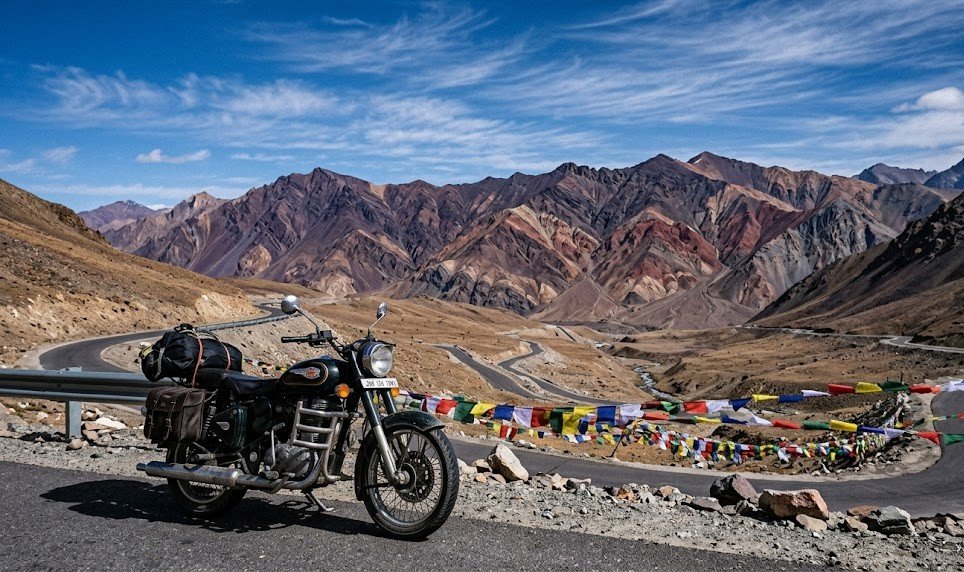
Ladakh — the Land of High Passes — sits at an average altitude of 3,500 metres in the rain shadow of the Himalayas. It is a cold desert of breathtaking contradictions: barren mountains painted in red, orange, and violet; ancient Buddhist monasteries clinging to cliffsides; blue lakes reflecting snow peaks; and roads that run at 5,000 metres above sea level — higher than the summit of Mont Blanc.
Every year, hundreds of thousands of Indians make the pilgrimage to Ladakh. Many on Royal Enfields. Many in Innova Crystas packed with friends. A few on bicycles. All of them leave changed.
This guide covers everything — both the two main routes, the essential permits, altitude sickness management, the must-see places, and the honest budget breakdown.
Two Routes to Leh — Manali vs Srinagar
| Feature | Manali–Leh Highway (NH3) | Srinagar–Leh Highway (NH1) |
|---|---|---|
| Distance | 479 km | 434 km |
| Duration (drive) | 2 days (1 night halt recommended) | 2 days (1 night halt recommended) |
| Highest Pass | Tanglang La (5,328 m) | Zoji La (3,538 m) |
| Road Condition | Rougher, more adventurous | Better road, more scenic valleys |
| Open Season | June to October only | May to November |
| Best For | Bikers, adventure seekers | Families, first-timers, car travellers |
| Highlights | Baralacha La, Sarchu, Tanglang La | Sonamarg, Drass, Kargil, Lamayuru |
Pro strategy: Go via Manali, return via Srinagar (or vice versa). You see entirely different landscapes and get the complete Ladakh experience in one trip.
Manali to Leh — Day-by-Day Breakdown
Day 1: Manali → Jispa (145 km)
Leave Manali by 5 AM to beat traffic on Rohtang Pass. The road climbs through Rohtang (3,978 m), drops into the Lahaul Valley, and follows the Bhaga River to Jispa. Camp or stay in a guesthouse here. Altitude: 3,200 m — a gentle acclimatisation stop.
Day 2: Jispa → Sarchu (85 km)
The most dramatic day on the highway. Cross Baralacha La (4,890 m) and descend to the Brandy Nala camping ground before climbing to Sarchu at 4,290 m. Sarchu sits on the Himachal-Ladakh border. Tented camps here are basic but the plateau views at night — Milky Way from 4,000 m — are spectacular.
Day 3: Sarchu → Leh (270 km)
The longest and highest day. Cross the Nakee La (4,739 m), the Lachulung La (5,059 m), and the famous Tanglang La (5,328 m) — one of the world's highest motorable passes. Stop at the More Plains (a 40 km flat plateau at 4,500 m where you might spot kiang — wild Tibetan donkeys), then descend through Upshi to Leh.
Leh — What to Do (Spend 3–4 Days Here)
Acclimatise First
Do not rush. The first two days in Leh should be gentle: walk slowly, drink 3–4 litres of water daily, avoid alcohol, eat light. Headaches and breathlessness are normal. Fever, vomiting, or confusion are not — descend immediately if these occur.
Leh Palace
A 17th-century nine-storey palace modelled on the Potala Palace in Lhasa. Now partially in ruins but the views from the top — over Leh town, the Indus Valley, and the mountains — are extraordinary. Rs 25 entry. Open 7 AM – 1 PM.
Shanti Stupa
A white-domed Buddhist stupa on a hilltop west of Leh, built by Japanese Buddhists in 1991. Best visited at sunset — the sky turns the mountains pink and gold behind the gleaming white dome.
Leh Market and Changspa Lane
The main bazaar sells pashmina shawls, turquoise jewellery, Ladakhi butter tea, and camping gear. Changspa Lane, parallel to the market, is lined with cafes, rooftop restaurants, and bakeries run by Tibetan families.
Must-Do Excursions from Leh
Nubra Valley (120 km from Leh)
Cross the Khardung La (5,359 m) — one of the world's highest motorable roads — to descend into the warm, green Nubra Valley. Highlights:
- Diskit Monastery: A 600-year-old monastery with a giant Maitreya Buddha statue overlooking the valley
- Hunder Sand Dunes: A surreal cold-desert dune field where you can ride double-humped Bactrian camels — found almost nowhere else in India
- Turtuk Village: The last Indian village before the Pakistan border. A stunning Balti cultural enclave with apricot orchards and hospitality that is deeply touching.
Permit needed: Inner Line Permit for Nubra Valley. Obtained easily from the DC office in Leh or online (Rs 20 per person).
Pangong Tso Lake (160 km from Leh)
The lake made famous by 3 Idiots. Pangong Tso is 134 km long, sits at 4,350 m, and changes colour through the day — turquoise, blue, deep violet — as the light shifts. 60% of the lake lies in China. The Indian side has campsites right on the shore where you can wake up to the lake at sunrise. One of the most visually stunning places on Earth.
Permit needed: Inner Line Permit. Overnight camping near the lake requires a separate permit.
Moriri Lake (240 km from Leh)
Less visited than Pangong but many say more beautiful. Tso Moriri sits at 4,522 m, surrounded by 6,000 m peaks and home to the black-necked crane — one of the rarest birds in Asia. The village of Korzok on its shore has a monastery and basic homestays.
Monasteries of Ladakh
| Monastery | Distance from Leh | Known For |
|---|---|---|
| Thiksey | 19 km | Resembles Potala Palace, 12-storey complex |
| Hemis | 45 km | Largest monastery in Ladakh, famous annual festival |
| Diskit | 120 km (Nubra) | Maitreya Buddha, valley views |
| Lamayuru | 127 km (Srinagar road) | Oldest monastery in Ladakh, moonland landscape |
| Alchi | 70 km | Ancient murals, Indo-Kashmiri Buddhist art |
Altitude Sickness — The Most Important Section
Acute Mountain Sickness (AMS) is real and can be life-threatening if ignored. Read this carefully.
Symptoms of AMS
- Mild (normal): Headache, fatigue, loss of appetite, breathlessness on exertion
- Moderate (be careful): Severe headache not relieved by paracetamol, vomiting, difficulty walking straight
- Severe (emergency — descend immediately): Confusion, inability to walk, pink frothy cough (HAPE), severe headache with confusion (HACE)
Prevention Rules
- If flying to Leh, rest completely for the first 24 hours. No monastery climbs, no hikes.
- Drink 4+ litres of water per day. No alcohol for first 3 days.
- Carry Diamox (Acetazolamide) 250mg — consult your doctor before the trip. Start 2 days before arriving at altitude.
- Acclimatise before going higher: Spend 2 nights in Leh before going to Pangong or Nubra.
- Golden rule: If in doubt, go down. No view is worth your life.
Permits Required for Ladakh
| Area | Indians | Foreigners | How to Get |
|---|---|---|---|
| Leh town | No permit | No permit | — |
| Nubra Valley | ILP required | PAP required | DC office Leh or online |
| Pangong Tso | ILP required | PAP required | DC office Leh or online |
| Tso Moriri | ILP required | PAP required | DC office Leh or online |
| Dha-Hanu | ILP required | Not permitted | DC office Leh |
ILP = Inner Line Permit (Rs 20–80 per person per zone). Apply at the DC office in Leh (near the main bazaar) or through e-permits portal. Takes 30–60 minutes. Bring ID proof and 2 passport photos.
Bike Trip vs Car Trip — Which is Better?
Bike (Royal Enfield)
Pros: Freedom, access to all roads, the legendary biker brotherhood on the highway, deeply personal experience.
Cons: Physically demanding, dangerous in rain, requires mechanical skills or a backup plan, very cold.
Rent in Manali or Leh: Rs 1,200–2,000 per day for a 350cc Himalayan or Bullet. Carry basic tools.
Car (Innova/Bolero/Scorpio)
Pros: Comfortable, fits 6–7 people, safer in bad weather, luggage space.
Cons: Less access to narrow trails, shared cost still adds up, driver needs experience on mountain roads.
Hire with driver from Manali: Rs 18,000–25,000 one-way to Leh (for the whole vehicle).
Budget Breakdown — 10-Day Ladakh Trip
| Expense | Budget (Rs) | Mid-Range (Rs) |
|---|---|---|
| Flights or bus to Manali | 2,000–4,000 | 5,000–12,000 |
| Manali–Leh transport (shared taxi/bike rental) | 2,500–4,000 | 6,000–15,000 |
| Accommodation (per night) | 400–800 | 1,500–4,000 |
| Food (per day) | 300–500 | 700–1,500 |
| Permits (all zones) | 300–500 | 300–500 |
| Local sightseeing (taxis) | 3,000–5,000 | 8,000–15,000 |
| Total 10-day trip (per person) | Rs 15,000–25,000 | Rs 40,000–70,000 |
Frequently Asked Questions
Is Ladakh safe for beginners?
Yes, if you fly into Leh and acclimatise properly. Thousands of first-time Himalayan travellers visit every year without any problems. The key is not rushing. Spend at least 2 days in Leh before heading to higher-altitude excursions.
When is the best time to visit Ladakh?
June to September is peak season with all roads open. July–August is busiest. October is quieter with stunning autumn colours. Winter (December–February) is for the adventurous — the Chadar Trek on the frozen Zanskar River runs in January–February.
Can I visit Ladakh without a bike or car?
Absolutely. Fly into Leh (direct flights from Delhi, Mumbai, Bangalore). Hire local taxis for all excursions. Shared taxis are available for Nubra, Pangong, and Moriri at a fraction of the cost of private vehicles.
What should I pack for Ladakh?
Thermal layers, windproof jacket, sunscreen SPF 50+ (UV is intense at altitude), good sunglasses, lip balm, Diamox, water bottle, power bank (cold drains batteries fast), and sturdy trekking shoes. Temperatures drop below 5°C even in summer nights.
Conclusion
Ladakh does something to people. You arrive as a tourist and leave as someone who has seen something they cannot quite explain — a landscape so large and silent that your own problems suddenly seem proportionate. The roads are hard, the altitude is real, and the logistics require planning. None of that matters once you're sitting at Pangong at dawn watching the lake go from black to silver to the deepest blue you've ever seen.
Planning your Ladakh trip and have specific questions — which route is better for your dates, how to book Nubra permits, or which monastery to prioritise? Ask on AskYatri.com — real travellers who have ridden every road will answer.
You Might Also Like