India has over 1.4 billion people, thousands of years of history, and landscapes that range from frozen Himalayan deserts to tropical rainforests. And yet — most tourists visit the same 10 places. Taj Mahal, Goa, Jaipur, Manali, Kerala. Again and again.
What if we told you that India's most extraordinary places are the ones nobody talks about?
This is not a list of "slightly less popular" destinations. These are genuinely hidden, jaw-dropping, off-the-beaten-path places that even experienced Indian travelers have often never visited. No massive tourist crowds. No overpriced hotels. Just raw, real, incredible India.
Here are 10 hidden gems in India that deserve to be on every traveler's bucket list.
Quick Overview — 10 Hidden Gems at a Glance
| # | Hidden Gem | State | Type | Best Time |
|---|---|---|---|---|
| 1 | Ziro Valley | Arunachal Pradesh | Nature + Culture | Mar–Oct |
| 2 | Dholavira | Gujarat | Ancient Heritage | Oct–Feb |
| 3 | Majuli Island | Assam | Island + Culture | Oct–Apr |
| 4 | Chopta | Uttarakhand | Himalayan Trek | Apr–Jun, Sept–Nov |
| 5 | Mawlynnong | Meghalaya | Village + Nature | Sept–May |
| 6 | Gandikota | Andhra Pradesh | Canyon + Fort | Oct–Feb |
| 7 | Unakoti | Tripura | Ancient Rock Art | Oct–Mar |
| 8 | Gokarna | Karnataka | Beach + Spiritual | Oct–Mar |
| 9 | Shekhawati | Rajasthan | Open Air Museum | Oct–Feb |
| 10 | Dzukou Valley | Nagaland | Valley + Trek | Jun–Sept |
1. Ziro Valley — Arunachal Pradesh
State: Arunachal Pradesh | Best Time: March–October | Type: Nature + Tribal Culture
Ziro Valley is one of the most beautiful and least visited places in all of India. A UNESCO World Heritage tentative site, this lush green valley in Arunachal Pradesh is home to the Apatani tribe — one of India's most fascinating indigenous communities known for their unique sustainable farming practices and rice-fish cultivation system.
The valley is surrounded by pine-covered hills, crisscrossed with streams, and dotted with traditional Apatani villages. Every September it hosts the Ziro Music Festival — India's most loved independent music festival set against a backdrop of mountains and rice paddies.
Why You Must Visit
- UNESCO tentative World Heritage site — almost no tourists
- Ziro Music Festival every September — unique open-air experience
- Apatani tribal villages — ancient culture, nose plugs, traditional tattoos
- Pine hill treks with panoramic valley views
- Some of the cleanest air and skies in India
How to Reach: Fly to Itanagar (Hollongi Airport) then drive ~150km. Requires Inner Line Permit (ILP) — get it online before travel.
Budget: ₹1,500–3,000 per day. Homestays with Apatani families are available and highly recommended.
Pro Tip: Book Ziro Music Festival accommodation 3–4 months in advance — it sells out every year. The festival happens in the last week of September.
2. Dholavira — Gujarat
State: Gujarat | Best Time: October–February | Type: Ancient Heritage
Most Indians know about the Taj Mahal and Hampi. Very few know about Dholavira — a UNESCO World Heritage Site and one of the largest and best-preserved cities of the ancient Indus Valley Civilisation, dating back 5,000 years.
Located on the remote Khadir island in the Rann of Kutch, Dholavira is an archaeological site of extraordinary scale — with elaborate water conservation systems, multi-layered city planning, and an ancient signboard that is one of the earliest examples of writing in the world. And almost nobody visits it.
Why You Must Visit
- UNESCO World Heritage Site — 5,000-year-old Indus Valley city
- Remarkable ancient water harvesting and reservoir systems
- One of the world's earliest known signboards on display
- Completely uncrowded — you may have the entire site to yourself
- Combine with Rann of Kutch White Desert visit
How to Reach: Drive from Bhuj (~250km). Bhuj is connected by train and flight from major cities.
Budget: ₹1,200–2,500 per day. Very few hotels nearby — book in advance.
Pro Tip: Combine Dholavira with the Rann Utsav festival (November–February) — the White Desert of Kutch turns silver under the full moon and is one of India's most magical experiences.
3. Majuli Island — Assam
State: Assam | Best Time: October–April | Type: River Island + Culture
Majuli is the world's largest river island — a vast, serene expanse of land in the middle of the Brahmaputra river in Assam. Home to 22 Vaishnavite monasteries (Satras) that are the living centers of Assamese neo-Vaishnavism, mask-making, dance, and classical music traditions stretching back 500 years.
The island is slowly shrinking due to river erosion — which means visiting Majuli now, while it still exists in its current form, is genuinely urgent. The landscape is extraordinary: bamboo groves, wetlands full of migratory birds, traditional stilt houses, and the vast grey-blue Brahmaputra stretching to the horizon.
Why You Must Visit
- World's largest river island — unique landscape
- 500-year-old Vaishnavite Satras (monasteries) with living traditions
- Traditional mask-making and classical Sattriya dance performances
- Migratory bird watching in winter (November–February)
- Cycle through the island at your own pace — completely flat terrain
How to Reach: Take a ferry from Jorhat (Nimati Ghat) — 1 hour crossing. Jorhat is connected by flight and train from Guwahati.
Budget: ₹1,000–2,500 per day. Monastery guesthouses are available and offer a truly immersive experience.
Pro Tip: Stay at a Satra guesthouse if possible — monks often welcome respectful guests and you may witness evening prayer ceremonies that are rarely seen by outsiders.
4. Chopta — Uttarakhand
State: Uttarakhand | Best Time: April–June, September–November | Type: Himalayan Trek + Meadows
Called the "Mini Switzerland of Uttarakhand", Chopta is a tiny hamlet at 2,680m surrounded by dense forests of oak, rhododendron, and pine. It is the base for the Tungnath Trek — the highest Shiva temple in the world at 3,680m — and the Chandrashila Summit at 4,130m with 360° Himalayan views.
While Kedarnath sees hundreds of thousands of pilgrims, Chopta and Tungnath remain blissfully quiet. The meadows (bugyals) around Chopta burst into rhododendron blooms in April-May and turn golden in October — making it one of the most beautiful seasonal landscapes in the Himalayas.
Why You Must Visit
- Tungnath — world's highest Shiva temple (3,680m)
- Chandrashila Summit — panoramic views of Nanda Devi, Trishul, Kedarnath peaks
- Rhododendron bloom in April-May — forests turn completely red
- Almost no crowds compared to Kedarnath and Valley of Flowers
- Winter snowfall makes it a magical snow trek destination
How to Reach: Drive from Rishikesh (~200km) or Haridwar. No direct public transport — hire a cab from Ukhimath.
Budget: ₹1,500–3,000 per day. Basic guesthouses and camping available.
Pro Tip: Start the Tungnath trek before 6 AM for completely clear Himalayan views — clouds usually roll in by 10–11 AM and obscure the peaks.
5. Mawlynnong — Meghalaya
State: Meghalaya | Best Time: September–May | Type: Village + Living Root Bridges
Mawlynnong was declared Asia's Cleanest Village in 2003 — and a visit confirms why. This small Khasi tribal village near the Bangladesh border is immaculate: bamboo dustbins on every corner, flower-lined pathways, and a community so proud of its environment that littering is genuinely unthinkable here.
But Mawlynnong is more than cleanliness. It sits at the edge of dramatic cliffs overlooking the Bangladesh plains, has a spectacular natural living root bridge nearby, and offers a rare glimpse into the matrilineal Khasi society where property and lineage pass through women.
Why You Must Visit
- Asia's Cleanest Village — genuinely immaculate, beautifully maintained
- Natural living root bridge — centuries-old tree roots trained into bridges
- Sky Walk viewpoint — panoramic view over Bangladesh plains
- Matrilineal Khasi culture — unique social structure in India
- Close to Dawki River — crystal clear water where boats appear to float on air
How to Reach: Drive ~90km from Shillong. Combine with Dawki River and Cherrapunji in a 3-day Meghalaya trip.
Budget: ₹1,200–2,500 per day. Village homestays available.
Pro Tip: Don't just visit Mawlynnong — combine it with Dawki River (30 minutes away) for the most surreal boat ride in India on crystal-clear water above a bright sandy riverbed.
6. Gandikota — Andhra Pradesh
State: Andhra Pradesh | Best Time: October–February | Type: Canyon + Fort
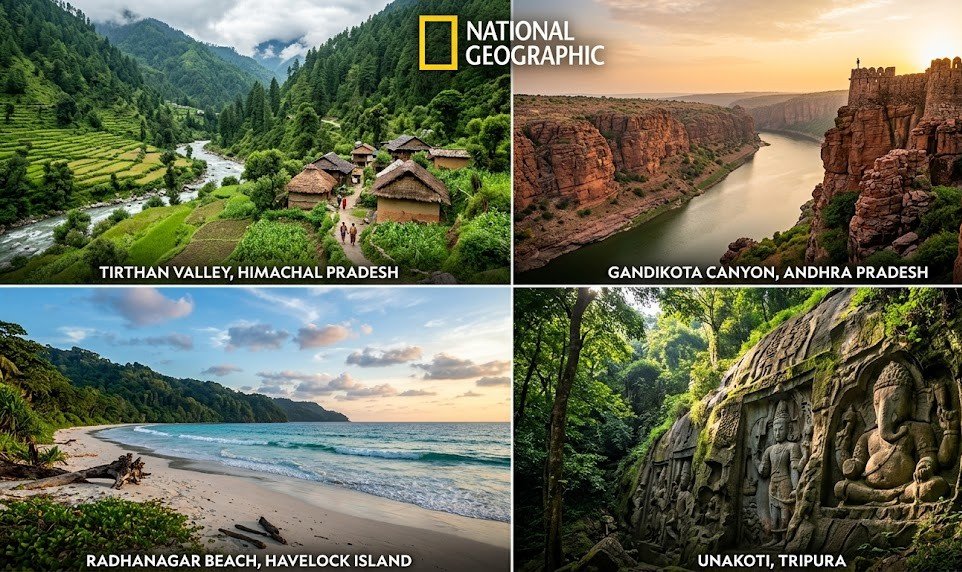
Called the "Grand Canyon of India", Gandikota is a spectacular gorge carved by the Penna river through rocky quartzite hills — creating dramatic red and orange canyon walls that drop sharply to the river below. Perched right on the canyon edge is the ancient Gandikota Fort, a medieval fortification that is one of the most dramatically situated forts in all of India.
Almost nobody outside Andhra Pradesh has heard of Gandikota. There are no crowds, no tour buses, and no overpriced restaurants — just raw, dramatic landscape and 800 years of history.
Why You Must Visit
- India's Grand Canyon — dramatic gorge with red canyon walls
- Gandikota Fort — one of India's most dramatically situated medieval forts
- Madhava Perumal Temple and Ranganatha Temple inside the fort complex
- Sunrise over the canyon — among the most spectacular in South India
- Completely uncrowded — virtually no tourist infrastructure yet
How to Reach: Drive ~140km from Kurnool or ~330km from Hyderabad. Nearest train station is Jammalamadugu.
Budget: ₹800–2,000 per day. AP Tourism has a small resort inside the fort complex — book well in advance.
Pro Tip: Book the Haritha Hotel inside the fort complex through AP Tourism — sleeping inside a medieval fort on the edge of a canyon is an experience worth planning around.
7. Unakoti — Tripura
State: Tripura | Best Time: October–March | Type: Ancient Rock Art + Mythology
Unakoti translates to "one less than a crore" — and the site lives up to its name. Hidden deep in the forests of northern Tripura are giant rock carvings and sculptures of Hindu deities — some standing 30 feet tall — dating back to the 7th–9th centuries. The largest is a colossal Shiva head flanked by two Ganga goddesses, all carved directly into a rock face.
Legend says that Lord Shiva was travelling with 10 million (one crore) gods to Kashi. When they stopped here and the gods fell asleep, Shiva left without them — and they were turned to stone. The result is one of India's most extraordinary and eerie archaeological sites — hidden in a jungle, visited by almost nobody.
Why You Must Visit
- 7th–9th century giant rock carvings — some 30 feet tall
- Colossal Shiva head — one of India's most striking ancient sculptures
- Dense jungle setting — mystical, atmospheric, completely uncrowded
- Sacred waterfalls on site — pilgrims bathe during Ashokastami festival
- Tripura's most extraordinary hidden heritage site
How to Reach: Drive ~178km from Agartala. Fly to Agartala from Kolkata or Guwahati.
Budget: ₹1,000–2,000 per day. Very basic accommodation nearby — stay in Kailashahar town.
Pro Tip: Visit in the early morning when the forest is misty and the light filters through the trees onto the carvings — the atmosphere is genuinely otherworldly.
8. Gokarna — Karnataka
State: Karnataka | Best Time: October–March | Type: Beach + Spiritual
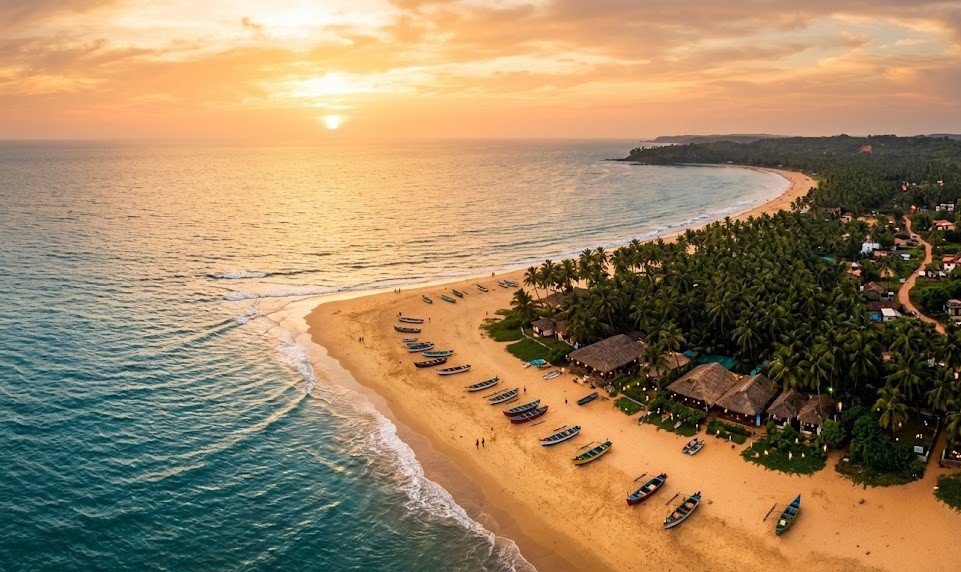
Gokarna is what Goa used to be 20 years ago — pristine beaches, no high-rise hotels, a genuine spiritual town with an ancient Shiva temple at its heart, and a relaxed traveler scene that hasn't been completely taken over by commercialism yet.
The beaches here — Om Beach, Half Moon Beach, Paradise Beach — are among the most beautiful in India. And unlike Goa, you can still find a quiet stretch of sand where the only sounds are waves and seabirds.
Why You Must Visit
- Om Beach — naturally shaped like the Om symbol, stunning cliff views
- Half Moon and Paradise Beach — pristine, accessible only by foot or boat
- Mahabaleshwara Temple — one of India's most sacred Shiva temples
- Kudle Beach — best sunset beach in Karnataka
- Trek between beaches along dramatic coastal cliffs
How to Reach: Train to Gokarna Road station (on Konkan Railway line) then auto to town. Or drive from Mangalore (~160km) or Goa (~140km).
Budget: ₹1,000–3,000 per day. Budget guesthouses and beach shacks available.
Pro Tip: Stay at Namaste Cafe on Om Beach or a guesthouse near Kudle Beach — both are significantly quieter and more beautiful than the main town beach.
9. Shekhawati — Rajasthan
State: Rajasthan | Best Time: October–February | Type: Open Air Museum
Shekhawati is called the "open air art gallery of Rajasthan" — and nothing prepares you for what you find here. The towns of Mandawa, Nawalgarh, Fatehpur, and Jhunjhunu are filled with hundreds of ancient merchant havelis (mansions) covered from floor to ceiling in the most extraordinary frescoes — painted in vivid colors depicting Hindu mythology, Mughal court scenes, European steam trains, and even early aircraft.
These havelis were built by wealthy Marwari merchant families in the 18th and 19th centuries as symbols of their prosperity. Most are now abandoned — you can simply walk in, look up, and marvel at ceiling paintings that would be in world-class museums anywhere else.
Why You Must Visit
- Hundreds of painted havelis — the world's largest open-air fresco collection
- Mandawa Fort — beautiful heritage hotel inside a real fort
- Nawalgarh — best concentration of frescoes in a single town
- Almost completely off the tourist trail despite being 3 hours from Delhi
- Authentic Rajasthani food and culture without tourist pricing
How to Reach: Drive ~200km from Delhi (3.5 hours) or take a train to Jhunjhunu or Sikar.
Budget: ₹1,500–4,000 per day. Several heritage haveli hotels available at surprisingly affordable prices.
Pro Tip: Hire a local guide in Nawalgarh for ₹300–500 — they know which havelis still have the best-preserved paintings and which are privately owned but open to respectful visitors.
10. Dzukou Valley — Nagaland
State: Nagaland (also accessible from Manipur) | Best Time: June–September | Type: Valley + Trek
Dzukou Valley is one of the most beautiful places in India that almost nobody has seen. Located at 2,452m on the border of Nagaland and Manipur, this vast high-altitude valley is blanketed every monsoon in an extraordinary carpet of Dzukou lilies — a flower found nowhere else on Earth — turning the entire valley white and pink.
The trek to Dzukou requires a full day's effort — but the reward is a valley so remote and pristine that it feels like another world. Bamboo shelters allow trekkers to spend the night and wake up to dawn mist rolling across the flower-covered slopes.
Why You Must Visit
- Dzukou lily bloom (July–August) — flowers found nowhere else on Earth
- High-altitude valley trekking at 2,452m with zero crowds
- Overnight camping in bamboo shelters inside the valley
- Rare birds including Blyth's Tragopan pheasant
- Gateway to Nagaland's extraordinary tribal culture
How to Reach: Drive to Viswema village (~20km from Kohima), then 4–5 hour trek to the valley. Fly to Dimapur from Kolkata or Guwahati, then drive to Kohima.
Budget: ₹1,500–3,000 per day. Basic bamboo shelter accommodation inside the valley.
Pro Tip: Visit in late July to mid-August for peak Dzukou lily bloom. Carry warm clothes — temperatures drop sharply at night even in summer. Permits required — arrange through your hotel in Kohima.
Why These Hidden Gems Are Better Than Popular Destinations
Every destination on this list offers something that the overcrowded tourist trail cannot — authenticity. No selfie crowds at the Taj. No overpriced beach shacks. No tourist menus. Just real India, in its raw, extraordinary, unfiltered form.
These places are hidden not because they are less beautiful or less interesting than the famous ones — but simply because the travel industry hasn't caught up with them yet. That window won't stay open forever. Places like Majuli, Dzukou Valley, and Ziro are changing fast.
Go now, before everyone else does.
Have questions about reaching any of these hidden gems — permits, transport, accommodation, safety? Ask the AskYatri community — real travelers who've been there answer your specific questions.
Frequently Asked Questions
Which is the most hidden gem in India that very few people know about?
Unakoti in Tripura and Dzukou Valley in Nagaland are among the least visited extraordinary places in India. Both are genuinely spectacular — giant 7th century rock carvings and a valley of rare lilies respectively — yet receive a tiny fraction of the visitors that comparable destinations receive.
Which hidden gem in India is easiest to reach from Delhi?
Shekhawati (Mandawa/Nawalgarh) is just 3.5 hours from Delhi by road — making it the most accessible hidden gem on this list. Gandikota and Gokarna are best reached from Hyderabad and Goa/Mangalore respectively.
Which hidden places in India are best for nature lovers?
Ziro Valley (Arunachal Pradesh), Dzukou Valley (Nagaland), Chopta (Uttarakhand), and Majuli Island (Assam) are the best hidden natural destinations in India — all extraordinary landscapes with minimal tourist infrastructure.
Are permits required to visit these hidden gems?
Yes — some destinations require permits. Ziro Valley (Arunachal Pradesh) requires an Inner Line Permit (ILP) available online. Dzukou Valley requires a permit arranged in Kohima. Dholavira and other destinations are freely accessible. Always check permit requirements before planning your trip.
Which hidden gem in India is best for a budget trip?
Gandikota, Mawlynnong, and Gokarna are the most budget-friendly hidden gems — all easily doable under ₹1,500 per day including accommodation and food. Hampi (nearby Gokarna) is one of India's cheapest destinations overall.
You Might Also Like