Why Meghalaya Should Be on Every Indian Traveller's List
Tucked between Assam and Bangladesh, Meghalaya is one of India's most underrated states. Home to the wettest village on Earth (Mawsynram), ancient double-decker living root bridges, and the emerald caves of Cherrapunji, this small northeastern state packs some of the most jaw-dropping natural wonders in Asia.
Yet most Indian travellers have never been there. This guide changes that.
Meghalaya at a Glance
| Detail | Info |
|---|---|
| Capital | Shillong |
| Best Time to Visit | October to May (avoid monsoon peak Jun–Aug) |
| Nearest Airport | Shillong Airport (SHL) or Guwahati (GAU, 3 hrs) |
| Language | Khasi, Garo, English |
| Inner Line Permit | Not required for Indians |
| Currency | INR |
| Budget (per day) | Rs 800–2,500 depending on accommodation |
Top 10 Places to Visit in Meghalaya
1. Double Decker Living Root Bridge, Nongriat
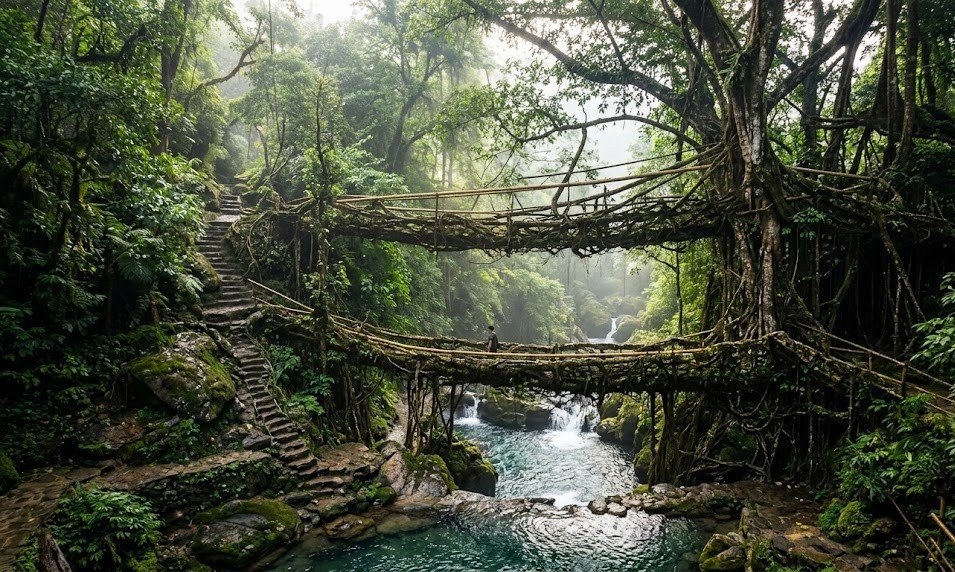
This is Meghalaya's most iconic sight — and rightly so. Over centuries, the Khasi people trained the aerial roots of rubber fig trees (Ficus elastica) across streams to form natural bridges. The double-decker root bridge at Nongriat is the crown jewel: two living bridges stacked on top of each other, entirely made by nature.
- Trek: 3,500 steps down and back up from Tyrna village (~6–7 hours round trip)
- Difficulty: Moderate to strenuous
- Tip: Stay overnight in Nongriat homestays to beat the crowds and experience the misty morning magic
- Entry Fee: Rs 50 per person
2. Cherrapunji (Sohra) — Waterfalls Capital of India
Once recorded as the wettest place on Earth, Cherrapunji (locally called Sohra) is 54 km from Shillong and is a base for spectacular viewpoints and waterfalls. Don't miss:
- Nohkalikai Falls — India's tallest plunge waterfall at 340 m. The tragic legend behind it makes it hauntingly beautiful.
- Seven Sisters Falls — Seven parallel cascades visible best during monsoon
- Mawsmai Cave — illuminated limestone cave, walkable in 30 minutes
- Eco Park — panoramic gorge views into Bangladesh
3. Mawlynnong — Asia's Cleanest Village
Awarded "Asia's Cleanest Village" by Discover India magazine in 2003, Mawlynnong has maintained its pristine status ever since. The village has zero plastic policy, bamboo dustbins on every corner, and a sky-walk treehouse overlooking Bangladesh.
Distance from Shillong: 90 km
Nearby: Single-decker living root bridge just 1 km walk away
4. Dawki — The Crystal Clear River
The Umngot River at Dawki is so transparent that boats appear to float in mid-air. The riverbed is clearly visible even at depth. It's the India-Bangladesh border crossing point and one of the most photogenic spots in the entire Northeast.
- Boating: Rs 300–500 per boat (shared)
- Best time: November to March (monsoon turns water murky)
- Tip: Visit on weekdays to avoid weekend crowds from Shillong
5. Shillong — The Scotland of the East
Meghalaya's capital Shillong is a hill station at 1,500 m with a unique Anglo-Indian character. Its pine forests, colonial architecture, and legendary music scene (it's the rock music capital of India) make it worth a 2-day stay.
Must-do in Shillong:
- Ward's Lake morning walk
- Shillong Peak for panoramic Himalayas view on clear days
- Police Bazaar for local food and shopping
- Don Bosco Museum — best tribal culture museum in Northeast India
6. Mawsynram — Wettest Place on Earth
Mawsynram receives an average of 11,871 mm of rainfall annually — the world record. During monsoon, the village is perpetually shrouded in cloud. A unique cave here has a shivalinga-shaped stalagmite formed entirely by calcium-rich rainwater dripping from above — a stunning natural phenomenon.
7. Krang Suri Waterfall
Located in the Jaintia Hills, Krang Suri is Meghalaya's most Instagram-famous waterfall — and for good reason. The bright turquoise pool at its base looks completely surreal against the surrounding jungle. Swimming is allowed, making it a popular stop on the Jowai circuit.
8. Balpakram National Park
Called the "Land of Perpetual Winds" by the Garo tribe, Balpakram is a plateau with deep gorges where the Garo people believe souls of the dead reside. It houses leopards, clouded leopards, red pandas, and rare orchids. Very few tourists visit — making it genuinely wild.
9. Laitlum Canyons
Just 25 km from Shillong, Laitlum (meaning "end of the hills" in Khasi) offers canyon views that rival anything in Rajasthan — but with green valleys instead of sand. The sunset here is extraordinary and it's far less visited than other Shillong day-trip spots.
10. Nartiang Monoliths
One of Meghalaya's most mysterious sites, the Nartiang monolith field contains the largest collection of monoliths in the world — tall stone slabs erected centuries ago by the Jaintia kings to honour the dead. The adjoining Durga temple adds a spiritual layer to this eerie landscape.
Meghalaya 7-Day Itinerary
| Day | Route | Highlights |
|---|---|---|
| Day 1 | Guwahati → Shillong | Arrive, Police Bazaar, Ward's Lake |
| Day 2 | Shillong local | Shillong Peak, Don Bosco Museum, Elephant Falls |
| Day 3 | Shillong → Cherrapunji | Nohkalikai Falls, Seven Sisters Falls, Mawsmai Cave |
| Day 4 | Cherrapunji → Nongriat | Double Decker Root Bridge trek, overnight stay |
| Day 5 | Nongriat → Mawlynnong → Dawki | Asia's Cleanest Village, crystal river boating |
| Day 6 | Dawki → Jowai → Krang Suri | Turquoise waterfall swim, Nartiang Monoliths |
| Day 7 | Shillong → Guwahati | Laitlum Canyons en route, departure |
How to Reach Meghalaya
By Air
The nearest major airport is Lokpriya Gopinath Bordoloi International Airport, Guwahati (GAU). From Guwahati, Shillong is a 3-hour drive (100 km). Shared sumos and cabs are available from Guwahati airport.
By Train
Meghalaya has no rail network. The nearest railway station is Guwahati, which is well-connected to Delhi, Kolkata, and other major cities.
By Road
From Guwahati, shared sumos (Rs 150–200) and private cabs (Rs 1,200–1,500) ply regularly to Shillong.
Budget Breakdown for Meghalaya (7 Days)
| Category | Budget (Rs) | Mid-Range (Rs) |
|---|---|---|
| Accommodation (per night) | 400–800 | 1,500–3,000 |
| Food (per day) | 300–500 | 700–1,200 |
| Local transport (per day) | 200–400 | 800–1,500 |
| Entry fees (total trip) | 300–500 | 500–800 |
| Total 7-day trip | Rs 9,000–16,000 | Rs 22,000–45,000 |
What to Eat in Meghalaya
Meghalayan cuisine is smoky, earthy, and unlike anything in mainstream India:
- Jadoh — Red rice cooked with pork, the staple Khasi dish
- Tungrymbai — Fermented soybean with pork fat — an acquired taste worth having
- Dohneiiong — Pork with black sesame gravy
- Pukhlein — Fried sweet rice cake, perfect as a snack
- Kwai — Betel nut offered as a gesture of hospitality — try it once!
Vegetarians: Shillong has good options in Laitumkhrah area including South Indian and Chinese restaurants.
Important Travel Tips for Meghalaya
- Carry cash: ATMs are scarce outside Shillong. Stock up before heading to villages.
- Respect tribal culture: Ask before entering sacred groves (Mawphlang). Photography norms vary.
- Wear good shoes: The root bridge trek involves 3,500+ stone steps. Trekking shoes are essential.
- Book homestays early: Nongriat has limited accommodation — book 2 weeks in advance in peak season.
- Don't drive in rain: Mountain roads become extremely slippery. Take sumos driven by locals.
- Hire a guide for caves: Some caves like Krem Liat Prah (longest cave in South Asia) require experienced guides.
Frequently Asked Questions About Meghalaya
Is Meghalaya safe for solo female travellers?
Yes — Meghalaya is one of the safest states in India for solo female travel. It is a matrilineal society (children take the mother's surname, daughters inherit property). Women are highly respected and the overall culture is welcoming and non-intrusive.
Do I need a permit to visit Meghalaya?
No Inner Line Permit is required for Indian nationals. Foreign nationals need a Protected Area Permit for some restricted areas like areas near the Bangladesh border.
When is the best time to visit Meghalaya?
October to May is ideal. October to February is the coolest and clearest. March to May brings spring blooms. Monsoon (June–September) is spectacular for waterfalls but roads can be dangerous.
Is Meghalaya expensive?
No. Meghalaya is very affordable. A budget traveller can manage on Rs 1,000–1,500 per day including accommodation, food, and local transport.
Conclusion — Why Meghalaya Is Unlike Anywhere Else in India
In a country overflowing with travel destinations, Meghalaya stands completely apart. It's the only place where you'll walk on bridges grown by trees, swim in electric-blue waterfalls, and eat in villages where women hold all the inheritance rights. It's spiritual without being crowded, wild without being inaccessible, and beautiful beyond description.
If you're planning a trip and have questions specific to Meghalaya — which village to stay in, how to find the best root bridge guide, or what to eat in Shillong — ask the community on AskYatri.com. Real travellers who've been there will answer.
You Might Also Like