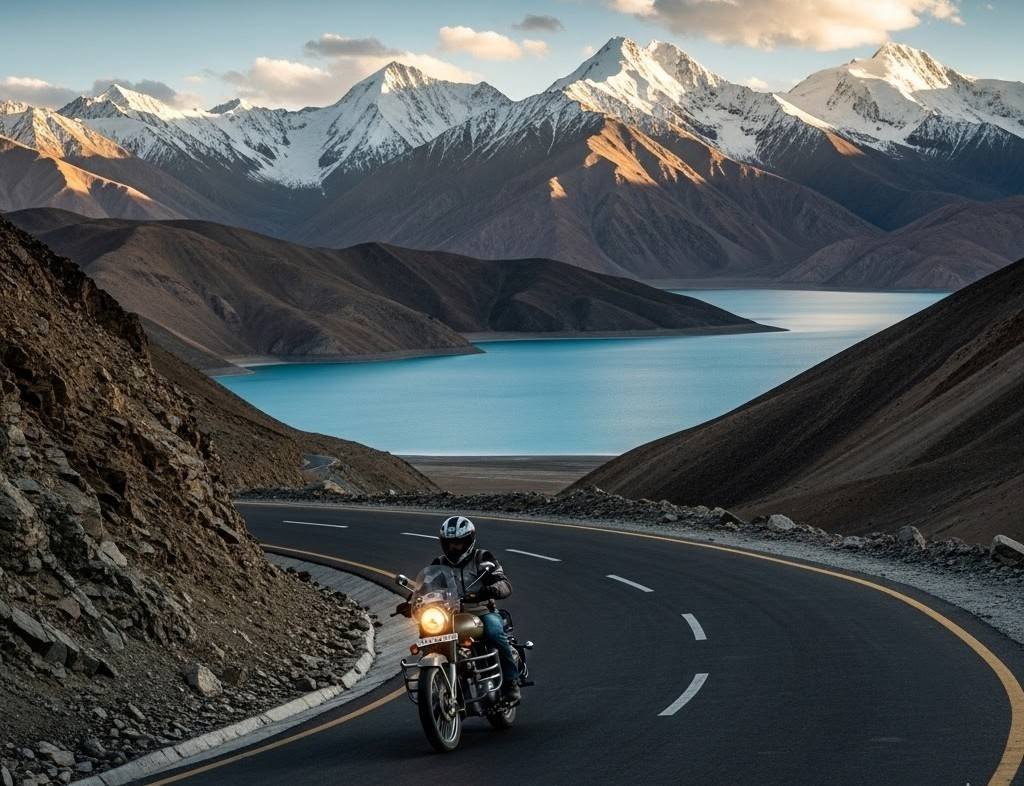
There is a moment somewhere on the Manali-Leh highway — usually around the Baralacha La pass, when the last tree has long since disappeared and the road stretches through a landscape so vast and so empty that your brain genuinely struggles to process the scale of it — where you understand why people come back to Ladakh again and again. It is not just beautiful. It is otherworldly. It feels like the planet showing you a version of itself that most people never get to see.
But Ladakh does not reward the unprepared. This is one of the highest inhabited regions on earth, with roads that close without warning, weather that changes completely in an hour, and altitudes that will put you in a hospital bed if you ignore what your body is telling you. The people who have the best experience here are almost always the people who prepared the best.
This guide exists to make sure you are one of those people.
Understanding What You Are Getting Into
Before anything else — routes, permits, bikes, packing lists — you need to understand the nature of what a Ladakh road trip actually is. This is not a weekend drive. It is not a holiday in the conventional sense. The roads cross five of the highest motorable passes in the world. Night temperatures even in July can drop below zero. Mobile network disappears for hundreds of kilometers at a stretch. Medical facilities beyond Leh city are limited to the point of being almost non-existent.
None of this is said to discourage you. It is said because the people who understand these realities before they leave are the ones who enjoy the trip. The people who discover these realities mid-journey are the ones who cut it short, get sick, or come back shaken rather than exhilarated.
Ladakh rewards respect. Give it that respect from the planning stage and it will give you an experience that genuinely changes how you see the world.
💡 Pro Tip: Read two or three detailed accounts from people who have done the trip in the same season you are planning. Not highlight reels — actual journey accounts with the problems they faced and how they dealt with them. This kind of preparation is more valuable than any packing list.
1. When to Go — The Window Is Smaller Than You Think
The road to Leh is open for a surprisingly short window each year and timing your trip correctly is one of the most important decisions you will make.
The Manali-Leh highway typically opens in late May and closes again by late October, depending on snowfall. June through September is the main travel season. July and August are peak months — the roads are fully open, temperatures are manageable, and all the high passes are accessible. These are also the most crowded months, prices go up, and guesthouses fill quickly.
June is excellent if you can manage it. The passes have just opened, the landscape still has remnants of snow at the high altitudes, and the light is extraordinary. Some stretches may be muddy from early snowmelt but nothing that a reasonably capable vehicle cannot handle.
September is perhaps the finest month of all. The crowds of peak summer have thinned, the skies clear to a deep, clean blue, the temperatures are still manageable during the day, and there is a golden quality to the light that makes every photograph look like it was taken by a professional. The roads are at their best and Pangong Lake in September is a colour that does not exist anywhere else on earth.
October is possible but requires careful planning. The Manali-Leh highway can receive early snowfall and close suddenly. If you are going in October, have a contingency plan and watch the weather obsessively.
💡 Pro Tip: If your schedule allows only one choice, choose September. Fewer crowds, better roads, lower prices, and the most beautiful light of the season. It is the month that produces most of the iconic Ladakh photographs you have seen online.
2. The Two Main Routes — Manali to Leh vs Srinagar to Leh
There are two primary road routes into Leh and choosing between them shapes the nature of your entire trip.
The Manali-Leh Highway is 479 kilometers and passes through some of the most dramatic high-altitude terrain in the world. It crosses Rohtang Pass, Baralacha La, Lachulung La, Nakee La, and Tanglang La — five high passes, the highest of which sits at over 5,300 meters. The road takes two days to drive comfortably, with a night halt at Sarchu or Jispa. It is raw, demanding, genuinely remote, and absolutely spectacular. This is the route that most people mean when they talk about the classic Ladakh road trip experience.
The Srinagar-Leh Highway is 434 kilometers and follows the Indus Valley for a significant portion of its length. It is generally better maintained, lower in altitude through much of the route, and passes through Kargil and the Zoji La pass. The landscape is different from the Manali route — less barren, more varied, with the Indus running alongside the road through long stretches of valley. Many people do one route in and the other route out, which gives you the best of both.
A third option — flying into Leh — is worth considering if your time is limited or if you have health conditions that make a multi-day high-altitude drive inadvisable. Leh airport is well-connected to Delhi, Mumbai, and several other major cities. Flying in and then doing the Manali-Leh highway on the way back is a popular and practical combination.
💡 Pro Tip: If you are doing the Manali-Leh route, do not attempt it in a single day under any circumstances. Two comfortable days with a halt at Jispa or Sarchu is the right pace. Rushing this road does not just reduce your enjoyment — it increases your risk of altitude sickness significantly by gaining elevation too quickly.
3. Bike vs Car — Choosing Your Vehicle Honestly
This debate runs through every Ladakh planning conversation and the honest answer is that neither is universally better — it depends entirely on who you are and what you want.
Riding a bike — most commonly a Royal Enfield Himalayan or a 350/500cc Bullet — gives you a physical, immersive experience that no car can replicate. The cold air, the road texture under the wheels, the ability to stop exactly where you want and be completely in the landscape rather than behind glass — it is a different relationship with the journey entirely. Riding Ladakh is something that people who have done it describe in a way that sounds almost spiritual. It also requires genuine riding experience, physical endurance, and the mechanical confidence to handle minor roadside repairs at 5,000 meters with no mechanic for a hundred kilometers in any direction.
Traveling by car — an Innova, a Scorpio, or ideally a vehicle with four-wheel drive — is more comfortable, more protective against the cold and the unexpected, and far better suited for groups, families, or anyone who wants to focus on the landscape rather than the road management. The views are the same. The passes are the same. The experience of arriving at Pangong Lake for the first time does not depend on what you arrived in.
If you are a first-timer to Ladakh and have never done mountain riding before, consider doing the first trip by car and the second by bike. The landscape will earn your complete attention and the experience will be rich enough without adding mechanical and physical demands on top.
💡 Pro Tip: Whatever you ride or drive, get the vehicle properly serviced before leaving Manali or Srinagar. Brake pads, engine oil, coolant, tyre pressure, and spare tyres — all of these need to be checked. Mechanics in Leh are good but reaching Leh with a failing vehicle after two days on mountain roads is not the experience you want.
4. Permits — What You Need and How to Get Them
Ladakh is a Union Territory with restricted areas that require specific permits. Getting this wrong means being turned back at checkpoints — so sort this out before you leave.
Inner Line Permit (ILP) is required for certain areas of Ladakh including Nubra Valley, Pangong Lake, Tso Moriri Lake, and the Dha-Hanu region. Indian nationals can obtain this online through the Ladakh tourism portal or in person at the DC office in Leh. It is straightforward and relatively inexpensive. Foreign nationals require a Protected Area Permit which has slightly different requirements and must be arranged in advance.
The permit specifies which areas you are traveling to and the duration of your stay. Make multiple copies — checkpoints will take one each time and you need to ensure you have enough to cover your entire route.
Rohtang Pass permit is separate and required before you even reach Ladakh — it's needed to cross from Manali side. This is obtained online through the Himachal Pradesh government portal and has a daily vehicle limit, so book it as soon as your travel dates are confirmed.
💡 Pro Tip: Apply for your Inner Line Permit online before leaving home rather than doing it in Leh. The online process takes minutes, the in-person queue at the DC office in Leh can take half a day during peak season. Print multiple copies — at least six to eight — because you will hand one over at each checkpoint.
5. Altitude Sickness — This Section Could Save Your Life
This is the most important section of this entire guide. Read it carefully.
Leh city sits at 3,500 meters. The high passes go up to 5,359 meters at Khardung La. The human body is not designed to function normally at these altitudes and it needs time to adjust. When it does not get that time, the result is Acute Mountain Sickness — AMS — which ranges from headaches and nausea at the mild end to High Altitude Pulmonary Edema and High Altitude Cerebral Edema at the severe end. The latter two are life-threatening and can develop within hours.
If you are flying directly into Leh, rest completely for the first 24 to 48 hours. Do not go sightseeing, do not exercise, do not climb stairs unnecessarily. Drink water constantly. Eat light. Give your body the time it needs to begin producing the red blood cells required to carry oxygen efficiently at altitude. This rest period is not optional — it is the most important preparation you will do.
Symptoms of AMS include persistent headache, loss of appetite, nausea, dizziness, fatigue, and disturbed sleep. Mild symptoms are normal in the first day or two and usually resolve with rest and hydration. If symptoms worsen rather than improve, or if you experience shortness of breath at rest, confusion, or an inability to walk straight — descend immediately. Do not wait to see if it improves. Do not push through. Descent is the only reliable cure for severe altitude sickness.
Diamox — acetazolamide — is commonly used to prevent and treat AMS. It works by stimulating faster breathing, which helps your body acclimatise more quickly. Talk to your doctor about dosage and timing before your trip, not after you arrive and start feeling unwell.
💡 Pro Tip: The golden rule of altitude is simple — if in doubt, go down. No view, no pass, no checkpoint is worth your health. The mountains will be there on another trip. Descend first and assess after. Every experienced Ladakh traveler has turned back at some point. It is wisdom, not failure.
6. What to Pack — Built for Ladakh Specifically
Packing for Ladakh requires thinking about temperature ranges that most people have never experienced before. The same day can see 25°C at noon and -2°C after sunset in high-altitude areas. Your packing list needs to cover both ends of that range simultaneously.
Thermal base layers are the foundation of everything — top and bottom, at least two sets. Over that go mid-layers like fleece jackets and over that goes a windproof and waterproof outer shell. The layering system matters because you will be removing and adding layers constantly as you move between altitudes and as the day temperature shifts.
Gloves, a warm hat that covers your ears, a neck gaiter, and UV-protective sunglasses are all non-negotiable. The sun at high altitude is stronger than anywhere you have experienced before and the combination of UV exposure and cold wind can leave your skin badly damaged within a single day without protection. Sunscreen SPF 50 or higher, applied generously and reapplied often, is essential.
A good quality sleeping bag rated to at least -10°C is important even if you are staying in guesthouses. Guesthouses in the higher areas — Nubra, Pangong, Tso Moriri — often have limited heating and temperatures inside can be genuinely cold overnight.
Medical kit requires specific attention for Ladakh. Beyond the standard paracetamol and antacids, carry Diamox, a pulse oximeter to monitor your blood oxygen levels, oral rehydration salts, and basic wound care supplies. A pulse oximeter is one of the most useful things you can carry — a reading below 85 percent at rest is a serious warning sign that your body is not coping with the altitude.
💡 Pro Tip: Buy a pulse oximeter before your trip and learn how to use it correctly. They cost ₹800 to ₹1,500 and give you objective data about how your body is handling the altitude. Checking your oxygen levels each morning takes thirty seconds and can be the difference between catching a problem early and being in serious trouble.
7. The Must-See Destinations — Build Your Route Around These
Ladakh is vast and trying to see everything in a single trip is a mistake that leads to exhausted, rushed travel. Choose your priorities and go deep rather than wide.
Pangong Tso Lake is the most iconic destination in Ladakh and for good reason. The lake stretches 134 kilometers across the India-China border and changes colour from turquoise to deep blue to silver depending on the light and the time of day. Arriving at Pangong for the first time — after the long drive from Leh through Chang La pass — is a moment that does not need any embellishment. It is exactly as extraordinary as you have been told.
Nubra Valley lies north of Leh across Khardung La and feels like a completely different world from the stark Changthang plateau. The valley floor has actual sand dunes — genuine desert dunes — sitting next to a glacial river, with snow peaks rising on all sides. The two-humped Bactrian camels that live here are not a tourist gimmick — they are descendants of the camels that carried goods along the Silk Route through this valley for centuries. Camp here overnight and experience a Ladakhi sky full of stars.
Tso Moriri Lake is less visited than Pangong and arguably more beautiful. At 4,522 meters, it is higher and more remote, the surrounding mountains more dramatic, and the silence more complete. If Pangong has become busy and photogenic, Tso Moriri still feels like a genuine discovery.
The monasteries — Thiksey, Hemis, Diskit, Lamayuru — deserve at least half a day each. Thiksey, built on a hilltop above the Indus Valley, looks like a smaller version of the Potala Palace in Lhasa and the view from its upper terrace at sunrise is one of the finest in Ladakh. Hemis is the largest and wealthiest monastery in Ladakh and its annual festival, held in June or July, is one of the most spectacular cultural events in the Himalayas.
💡 Pro Tip: Do not try to cover Pangong, Nubra, and Tso Moriri in a single loop without at least 7 to 8 days in Ladakh after acclimatisation. Each destination deserves an overnight stay — driving to Pangong, taking photographs, and driving back the same day is one of the most common ways to underexperience Ladakh.
8. Where to Stay — From Leh Hotels to Homestays
Leh city has accommodation ranging from budget guesthouses at ₹600 per night to mid-range hotels at ₹2,500 to ₹4,000. The area around the main market and the Changspa neighbourhood are both good bases — close to restaurants, shops, and the permit office.
Beyond Leh, the accommodation picture changes significantly. In Nubra Valley, Pangong, and Tso Moriri, the options are mostly camps and basic guesthouses. The camps at Pangong — those white tent clusters you see in photographs right on the lakeshore — range from basic to surprisingly comfortable. Prices go up during peak season and booking in advance is essential for July and August.
Homestays are genuinely the best way to experience Ladakhi culture and hospitality. Staying with a local family — eating their food, sitting in their kitchen in the evening, waking up to the same view they have woken up to their entire lives — gives you a connection to the place that no hotel can replicate. The Ladakh Tourism department has a registered homestay program that covers most of the main villages.
💡 Pro Tip: Book your Leh accommodation before leaving home and your Pangong or Nubra camp at least a week ahead during peak season. Arriving without a booking in July or August — particularly at Pangong — means either paying emergency prices or driving back to Leh in the dark.
9. Food, Fuel, and Money — The Practical Realities
Food in Leh is varied and surprisingly good — the main market has everything from traditional Ladakhi thukpa and skyu to standard Indian dal-roti to momos and Tibetan butter tea. Beyond Leh, options thin out quickly. In remote areas — Sarchu, Hanle, the road to Tso Moriri — you are dependent on dhabas that serve simple food, usually dal, rice, and roti. Carry biscuits, dry fruits, and high-energy snacks in your vehicle at all times.
Fuel is available in Leh, Kargil, Diskit in Nubra, and a few other key points. Beyond these, it can be a very long way to the next pump. Always fill up completely before leaving any fuel point and carry an extra can of petrol or diesel depending on your vehicle. Running out of fuel on a remote Ladakhi road is not a minor inconvenience — it is a serious problem.
ATMs exist in Leh but they run out of cash regularly during peak season. Card machines are rare outside the city. Carry enough cash from Manali or Srinagar to cover your entire time in the region — including a buffer for emergencies.
💡 Pro Tip: Carry at least ₹15,000 to ₹20,000 in cash when entering Ladakh, even if you plan to use cards where possible. Between fuel, permit fees, camp payments, and the inevitable unexpected expense, running out of cash in a remote area with no ATM for 200 kilometers is a situation you want to plan against.
10. Budget — What a Ladakh Road Trip Actually Costs
Ladakh is not a budget destination in the way that Goa or Rishikesh can be. The distances are large, fuel is expensive, permits have costs, and the remoteness drives up prices for accommodation and food in certain areas. That said, it is entirely possible to do the trip without spending more than is necessary if you plan carefully.
A rough per-day budget for a rider or traveler covering accommodation, food, fuel share, and activities comes to somewhere between ₹2,500 and ₹4,500 depending on your choices. A 12 to 15 day Ladakh trip — covering the journey from Manali, time in Leh for acclimatisation, Nubra, Pangong, Tso Moriri, and the return — costs roughly ₹35,000 to ₹55,000 per person when you factor in bike rental or fuel costs, permits, accommodation, food, and a contingency buffer.
If you are renting a bike, factor in ₹1,000 to ₹1,800 per day for a Royal Enfield Himalayan from a reputable rental company in Manali or Leh. Shared car hire from Leh for the major routes typically runs ₹4,000 to ₹7,000 per day for the vehicle.
💡 Pro Tip: Always keep a contingency fund of at least ₹8,000 to ₹10,000 separate from your main travel budget. Road closures, medical needs, extended stays due to weather, or mechanical repairs can all add unexpected costs. Ladakh is not the place to be financially unprepared for the unexpected.
11. Responsible Travel in Ladakh — This Matters More Than You Think
Ladakh's ecosystem is extraordinarily fragile. The high desert receives very little rainfall, the soil is thin, and the natural landscape takes decades to recover from damage. The tourism boom of recent years has brought significant plastic waste, unregulated camping, and environmental pressure to areas that were pristine not long ago.
Carry every piece of your waste out with you. Do not leave anything at campsites, roadsides, or near the lakes. Pangong Tso and Tso Moriri are particularly vulnerable — plastic on or near these lakes directly affects the wildlife and the water quality of ecosystems that support rare migratory birds and the nomadic communities who have lived here for generations.
Interact with the local Ladakhi communities — Tibetan Buddhist, Aryan, and Shia Muslim — with genuine curiosity and respect. Ask before photographing people. Buy from local shops rather than chain stores. Support guesthouses and camps owned by local families rather than outside operators.
💡 Pro Tip: Carry a reusable water bottle and a portable water filter or purification tablets. Refilling from glacial streams is possible on many stretches and eliminates the need for plastic bottles entirely. It is one small decision that makes a real difference when multiplied across every traveler who makes it.
Before You Pack Your Bags
Ladakh will be the most physically demanding journey most people who take it have ever done. It will also, for most of those same people, be the most beautiful. There is something about a landscape at that scale and that altitude — the silence, the light, the sheer geological age of what you are looking at — that gets under your skin in a way that ordinary beautiful places simply do not.
Prepare thoroughly. Acclimatise properly. Listen to your body more than you listen to your schedule. And when you cross Khardung La or stand at the edge of Pangong Tso for the first time and realise that the photographs you had seen for years did not actually do it justice — remember that the preparation is what got you there.
The road is waiting. It has been waiting for a very long time.
Julley.
You Might Also Like