There is a specific shade of terracotta pink that exists only in Jaipur. You notice it first when you enter the old city — the walls, the archways, the shopfronts, the havelis — all washed in this warm, dusty rose that glows differently at every hour of the day. At sunrise it looks almost golden. At noon it's bold and unapologetic. At sunset it turns a deep amber that makes you stop walking and just stare.
Jaipur is one of those cities that rewards you for slowing down. It has forts that took decades to build, bazaars that have been selling the same things for centuries, and food that is so rooted in the land it could not have come from anywhere else. Three days here is not a lot of time — but three days planned well is enough to leave with a full heart and a long list of reasons to come back.
This is that plan.
Day 1 — Forts, Palaces, and the Old City at Its Best
Start Before the Crowds Do — Amber Fort at Sunrise
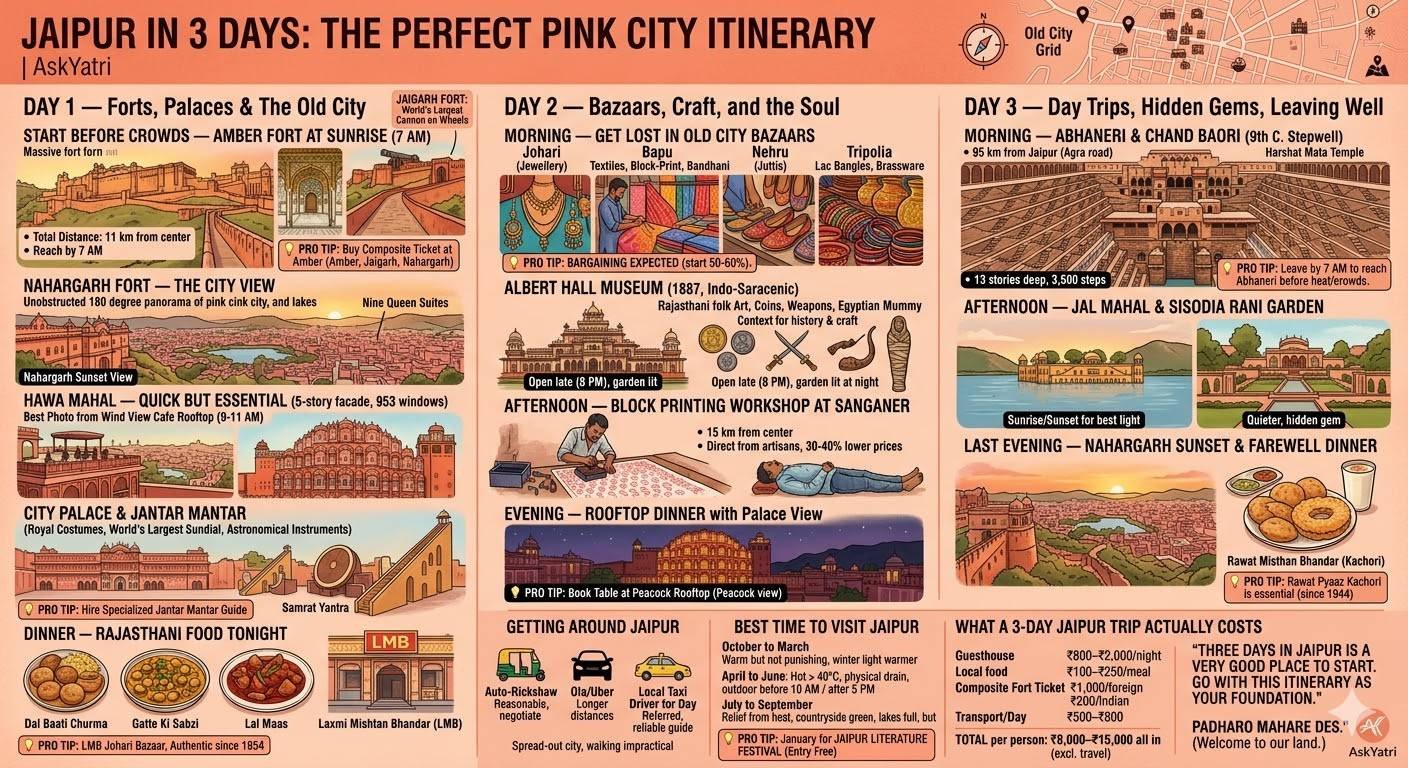
Wake up early on your first day. Not reluctantly-early — genuinely, set-your-alarm early. Amber Fort, sitting on a ridge 11 kilometers from the city center, is one of the most magnificent structures in Rajasthan, and it looks entirely different before the tour buses arrive.
Reach by 7 AM and you'll have the courtyards, the Sheesh Mahal with its mirror-mosaic ceiling, and the long climb up the ramparts almost entirely to yourself. The fort was the seat of the Kachwaha Rajput rulers for centuries and every surface of it — the carved latticed screens, the painted ceilings, the jaali windows — reflects that obsessive attention to craft and beauty.
Give yourself at least two hours here. Walk all the way up to Jaigarh Fort, connected to Amber by an underground passage, where the world's largest cannon on wheels sits quietly in the courtyard. The view of the valley from Jaigarh in the morning light is one of those views that makes the early wake-up feel like a very good decision.
💡 Pro Tip: Buy the composite ticket that covers Amber, Jaigarh, and Nahargarh Fort together. It saves money and avoids separate queues at each gate. The ticket is available at the Amber Fort entrance itself.
Nahargarh Fort — The City View Nobody Talks About Enough
After Amber, drive up to Nahargarh Fort on the ridge above the old city. Most visitors skip this one in favour of more famous sites, and that is genuinely their loss. Nahargarh sits at a height that gives you an unobstructed 180-degree view of Jaipur below — the pink grid of the old city, the lakes, the temples, and the Aravalli hills stretching into the distance.
The fort itself has an interesting interior — nine identical suites built by Maharaja Sawai Ram Singh for his nine queens, each connected by a central corridor so the king could visit each one with strict architectural fairness. Walk through the empty rooms and imagine what life inside those walls actually looked like.
💡 Pro Tip: Nahargarh Fort at sunset is one of the most spectacular views in all of Rajasthan. If you can manage it on Day 1, come back here in the evening. The city turning pink in the fading light from that height is something you will remember for a long time.
Hawa Mahal — Quick but Essential
No trip to Jaipur is complete without seeing Hawa Mahal — the Palace of Winds — even if just from the outside. The five-story facade with its 953 small windows was built so the royal women could observe street festivals without being seen. From the front, in the late morning light, it is genuinely one of the most photogenic structures in India.
Go inside if you have time — the view of the old city from the upper windows is surprisingly good — but the experience from the street is honestly just as satisfying. The best photographs of Hawa Mahal come from the rooftop of the Wind View Cafe directly across the road. Have a chai there, get your photographs, and move on.
💡 Pro Tip: The best light for photographing Hawa Mahal is in the morning when the sun hits the facade directly. By midday it falls into shadow. If photography matters to you, plan this stop between 9 and 11 AM.
City Palace and Jantar Mantar — An Afternoon Well Spent
City Palace sits at the heart of the old city and is still partially occupied by the royal family of Jaipur. The museum inside contains an extraordinary collection — royal costumes, weapons, manuscripts, and two enormous silver vessels that hold the Guinness record for the largest sterling silver objects in the world. Maharaja Sawai Madho Singh II had them made to carry Ganges water to England so he could bathe in sacred water during his visit to King Edward VII's coronation.
Right next to City Palace is Jantar Mantar — a collection of astronomical instruments built by Maharaja Sawai Jai Singh II in the early 18th century. The Samrat Yantra here is the world's largest sundial and is accurate to within two seconds. It sounds dry on paper but walking through Jantar Mantar is a genuinely strange and fascinating experience — these enormous, abstract stone structures that look like modern sculpture but are actually precision scientific instruments built three hundred years ago.
💡 Pro Tip: Hire a guide specifically for Jantar Mantar — not a general guide, but one who specialises in the astronomical instruments. Without context, the structures look interesting but mysterious. With a good guide explaining how each instrument works, it becomes one of the most memorable hours of the trip.
Dinner — Eat Rajasthani Food Tonight
Your first evening in Jaipur should involve a proper Rajasthani thali. The city has no shortage of places serving it, but the experience at a restaurant like Chokhi Dhani — a themed Rajasthani village complex on the outskirts of the city — or Laxmi Mishtan Bhandar in the old city gives you the full picture of what the cuisine actually is.
Dal baati churma, gatte ki sabzi, ker sangri, lal maas — these are not dishes you can find anywhere else in quite the same way. Tonight is the night to try all of them.
💡 Pro Tip: Laxmi Mishtan Bhandar in Johari Bazaar — locally known as LMB — has been feeding people in Jaipur since 1954. The thali here is honest, authentic, and reasonably priced. Go here for dinner on your first night before trying anything else.
Day 2 — Bazaars, Craft, and the Soul of the Pink City
Morning — Get Lost in the Old City Bazaars
Day two belongs to the old city's markets. Jaipur has been a centre of craft and trade for three hundred years and the bazaars reflect that history in every shop and every lane.
Johari Bazaar is where the jewellers are — Jaipur is one of the world's leading centres for gemstone cutting and jewellery, and even if you're not buying, watching the craftsmen work in tiny workshops behind the shops is worth the visit. Bapu Bazaar is where the textiles are — block-printed fabrics, bandhani dupattas, embroidered cushion covers, and Rajasthani quilts in colours that seem too vivid to be real.
Nehru Bazaar has juttis — the traditional Rajasthani embroidered leather shoes — in every colour and style imaginable. Tripolia Bazaar sells lac bangles and brassware. And threading through all of it are the chai stalls, the mithai shops, and the smell of something frying somewhere that you should absolutely follow and investigate.
💡 Pro Tip: Bargaining in Jaipur bazaars is expected and completely normal. Start at 50 to 60 percent of the quoted price and settle somewhere in the middle. Shopkeepers who say "fixed price" almost always have a little room if you're polite and patient.
Albert Hall Museum — Underrated and Worth Your Time
Most visitors to Jaipur skip Albert Hall Museum entirely, which means you should absolutely go. The building itself — a stunning Indo-Saracenic structure built in 1887 — is as interesting as anything inside it. The collection covers Rajasthani folk art, ancient coins, weapons, textiles, and a remarkable Egyptian mummy that has been there since 1895.
It's not a massive museum and you won't need more than 90 minutes, but it gives you a context for Rajasthan's history and craft traditions that makes everything else you see in the city feel richer and more connected.
💡 Pro Tip: The Albert Hall Museum garden is beautifully lit at night and the museum stays open until 8 PM on most days. If you find yourself near it in the evening, the building after dark is even more beautiful than during the day.
Afternoon — Block Printing Workshop at Sanganer
About 15 kilometers from the city centre is Sanganer — a town that has been producing hand block-printed textiles for centuries. Several workshops here allow visitors to come in, watch the process, and try it themselves. The experience of watching a craftsman line up a carved wooden block, press it into dye, and stamp a perfectly precise pattern onto fabric — repeated hundreds of times to build up a complex design — is genuinely humbling.
Most workshops have a small shop attached and the prices here are significantly better than in the city bazaars because you're buying directly from the people who made it.
💡 Pro Tip: If you're planning to buy block-printed textiles in Jaipur, buy them in Sanganer rather than the city markets. Same quality, the same craftsmen, 30 to 40 percent lower prices.
Evening — Rooftop Dinner with a Palace View
Jaipur has some of the best rooftop restaurants in India and your second evening is the right time to use one. Several restaurants near Hawa Mahal and City Palace offer rooftop seating with direct views of the illuminated monuments at night. The old city at night, lit up against a dark sky, looks like a film set — except it's completely real and has looked more or less like this for three centuries.
Order slowly, eat well, and just sit with the view for a while.
💡 Pro Tip: The rooftop at Peacock Rooftop Restaurant near Hawa Mahal gives you a direct view of the illuminated palace facade. Book a table in advance on weekends — it fills up quickly after 7 PM.
Day 3 — Day Trips, Hidden Gems, and Leaving Well
Morning — Abhaneri and Chand Baori
About 95 kilometers from Jaipur, on the road toward Agra, is Abhaneri village and within it one of the most extraordinary structures in Rajasthan — Chand Baori, a stepwell built in the 9th century. It descends 13 stories into the earth, with 3,500 narrow steps arranged in a perfect geometric pattern on three sides and a royal pavilion on the fourth. It is one of the deepest and most visually stunning stepwells in India.
Most Jaipur visitors never make it here, which makes it all the more worth the drive. Combine it with a visit to Harshat Mata Temple next door and you have a morning that feels genuinely off the tourist trail.
💡 Pro Tip: Leave Jaipur by 7 AM to reach Chand Baori before the heat and the day-trippers from Agra arrive. An hour here in the early morning, when the light falls into the stepwell at an angle, is a completely different experience from visiting at noon.
Afternoon — Jal Mahal and Sisodia Rani Garden
Jal Mahal — the Water Palace — sits in the middle of Man Sagar Lake and is one of those images of Jaipur that appears on every postcard. You cannot go inside but the view from the lakeside promenade, with the palace sitting perfectly still in the water and the Aravalli hills behind it, is worth the stop.
A short distance away is the Sisodia Rani Garden — a terraced Mughal-style garden built by Maharaja Sawai Jai Singh II for his second queen. It's quieter, less visited, and genuinely beautiful. Fountains, painted pavilions, and green terraces climb the hillside above the garden. It's one of those places that feels like a secret even though it's been there for three hundred years.
💡 Pro Tip: Visit Jal Mahal in the early morning or at sunset when the light is soft and the lake reflects the palace perfectly. Midday light is harsh and the photographs never look as good.
Last Evening — Nahargarh Sunset and Farewell Dinner
Come back to Nahargarh Fort for your last evening in Jaipur. You saw it on Day 1 — now see it at sunset. The city below turns every shade of pink and gold as the light fades, and for about twenty minutes everything looks almost impossibly beautiful.
Come down from the fort after dark and find a place in the old city for your last meal — something simple, something local, something that tastes like Jaipur. A kachori from a street stall, a glass of lassi so thick you eat it with a spoon, a bowl of ghewar soaked in rabri. These are the flavours you'll be trying to recreate at home for months afterward and never quite getting right.
That's how you know a city got to you.
💡 Pro Tip: Rawat Misthan Bhandar near Station Road is the most famous kachori shop in Jaipur. It has been open since 1944 and the line moves quickly. Go for breakfast on any morning or a quick evening snack — the pyaaz kachori here is one of the best things you will eat in Rajasthan.
Getting Around Jaipur — What Works Best
Jaipur is a spread-out city and the distances between attractions make walking impractical for most of the itinerary. Auto-rickshaws are available everywhere and rates are reasonable — always negotiate before getting in or use the meter. Ola and Uber both operate in the city and are reliable for longer distances like the Amber Fort drive or the Sanganer trip.
For a full day of sightseeing, hiring a local taxi driver for the day — negotiated in the morning — often works out cheaper and more convenient than booking separate rides each time. A good driver who knows the city well is worth a little extra.
💡 Pro Tip: Ask your hotel to recommend a trusted local driver for the day. Hotel-referred drivers are usually reliable, know the best routes, and often become informal guides who share information about the city that you would not find in any guidebook.
Best Time to Visit Jaipur
October to March is the ideal window. Days are warm but not punishing, evenings are cool, and the light that falls on the pink stone of the old city in winter is warmer and more beautiful than at any other time of year.
April to June is hot — genuinely, seriously hot. Temperatures cross 40°C regularly and sightseeing becomes physically draining by mid-morning. If you must visit in summer, plan all outdoor activities before 10 AM and after 5 PM.
July to September brings some relief from the heat but also rain. The countryside turns green, the lakes fill up, and the city looks lush in a way that is unexpected and lovely. It is a perfectly valid time to visit as long as you're prepared for occasional heavy showers.
💡 Pro Tip: January is when the Jaipur Literature Festival takes place — one of the largest literary festivals in Asia. If you have any interest in books, ideas, or simply watching extraordinary conversations happen in a beautiful setting, plan your visit around it. Entry is free.
What a 3-Day Jaipur Trip Actually Costs
Jaipur is one of the more affordable major cities in India for tourists. A decent guesthouse in the old city area runs between ₹800 and ₹2,000 per night. Food at local restaurants costs ₹100 to ₹250 for a full meal. The composite fort ticket is around ₹1,000 for foreign tourists and ₹200 for Indian nationals. Transport across the city for a full day — including Amber Fort — comes to roughly ₹500 to ₹800 depending on how much you move around.
A well-planned three-day trip for one person, covering all the major sites, eating well, and doing the Abhaneri day trip, comes to somewhere between ₹8,000 and ₹15,000 all in — excluding your travel to and from Jaipur.
💡 Pro Tip: The Jaipur City Palace entry includes access to the museum and the main courtyards but the private royal quarters require a separate premium ticket. Decide in advance whether the extra cost is worth it for you — the standard ticket already covers most of what makes the palace worth visiting.
Before You Leave for Jaipur
Three days in Jaipur will not be enough. You will leave with a list of things you did not get to — the puppet shows, the gem factories, the cooking classes, the villages beyond the city limits, the lesser-known temples that nobody told you about. That is not a failure of planning. That is Jaipur doing what every great city does — giving you more than you can hold in one visit.
Go with this itinerary as your foundation. Let yourself get pulled off it when something interesting appears. Stop when a street catches your eye. Follow the smell of something cooking. Talk to the people in the shops — not just to bargain, but because they have things to tell you about this city that no guidebook ever will.
The Pink City has been waiting. Three days is a very good place to start.
Padharo Mahare Des.
You Might Also Like